Author name: fiaz_ezaccounts

Wholesale Weighted Blankets: A Bulk Buyer's Guide for Hospitality & Wellness Businesses
Bedding

Wholesale Weighted Blankets: A Bulk Buyer’s Guide for Hospitality & Wellness Businesses

If you own a boutique hotel in Vancouver, you are weighing a weighted blanket amenity against two numbers, the review score it lifts and the housekeeping minutes it adds. If you run a spa in Calgary, you are weighing a treatment add-on against the cost of sanitising it between clients. If you manage rentals in Toronto and Montreal, you are weighing a five-star detail against the guest who spills wine on it in week two. Wholesale weighted blankets are bought differently by each of you, and the quote that suits one business is wrong for the other two. The guide below covers what each business is buying and the stock it needs. What Each Business Is Buying, and How Much of It A weighted blanket programme is two items, the inner blanket and the removable cover, and the ratio between them is where the money goes. The specification itself, from fill to weight to safety procedure, is covered in [choosing wholesale weighted blankets for hotels, spas and wellness facilities] The guide below assumes it and starts where the owner’s questions start. Boutique and Luxury Hotels: An Amenity That Earns Its Housekeeping Time For a hotel owner the blanket is a pillow-menu line, and the two costs are the stock and the minutes. A blanket offered on request is taken by 10 to 20 percent of guests, so a 100-room property stocks 10 to 20 inner blankets rather than 100. The cover changes between guests the way a duvet cover does. The housekeeping cost is a cover change on the rooms that asked, not on every room. A cover in the same bamboo as the sheets your luxury rooms already run reads as part of the bed rather than an addition. The guest who requested it mentions it in the review. Business Stock basis Inner blankets Covers per blanket Boutique or luxury hotel, pillow menu 10 to 20 percent of rooms 10 to 20 per 100 rooms Three Spa or wellness studio One per treatment room in use, plus one Rooms plus one Four, one per session slot in the day Vacation rental or Airbnb portfolio One per unit, placed One per unit, plus 10 percent spares Two, one on and one in the wash Spas and Wellness Studios: A Treatment Add-On That Sanitises in Minutes For a spa owner the blanket is billable, and the question is whether it can be turned between clients without slowing the room. The cover is the answer. One cover per session slot means the therapist strips and replaces it with the table linens, and the inner blanket stays on the table all day. A spa that already changes percale duvet covers between treatments adds the blanket cover to the same routine. Four covers per blanket keeps a six-session day supplied with one laundry run. Vacation Rentals and Airbnb: A Detail That Has to Survive the Guest For a property manager the blanket is placed, not offered, so every unit needs one and every guest will use it. The concern is damage and replacement, because there is no housekeeper on site to catch a spill before checkout. Two covers per unit, with the spare left in the closet for the cleaner, keep the blanket presentable between turnovers. A 10 percent spare stock of inner blankets covers the one that comes back stained. A portfolio that runs its own percale programme across managed properties treats the blanket as one more item on the linen count per unit. What Moves the Unit Price Four things move the price of a wholesale weighted blanket, and a quote that does not itemise them is hard to compare across suppliers. Fill: glass microbeads cost more than plastic pellets per pound and produce a thinner, cooler blanket Weight: a 20-pound blanket carries a third more fill and freight than a 15-pound one Cover fabric: cotton sateen, bamboo viscose and minky polyester sit at different price points Construction: smaller pockets and double-stitched seams add sewing time and add service life Freight is the fifth line. A carton of weighted blankets is heavy for its size. Delivery to Vancouver or Calgary from an eastern warehouse costs more per unit than delivery to Toronto or Montreal, so request a quote with the delivery address on it. Covers cost a fraction of the blanket and are the item that turns. That is why the cover order is placed first and sized larger, on the same three-to-one logic as commercial duvet covers in a laundry operation. Choose Between Stocked, Custom and Private Label The order type decides the minimum, the lead time and whether you can specify the weight and the cover fabric. Most first orders are stocked, and most reorders that follow a successful programme move to custom or private label. Stocked Blankets and Covers Stocked weighted blankets ship by the carton from Northern Linens’ Canadian and US warehouses, usually within a few business days, in the standard weights and the standard cover fabrics. A property trying the amenity for the first time orders a carton of blankets and three cartons of covers. The property samples one of each in its own laundry and reorders on the same specification. The minimum is the carton, which suits a single property. Order type You choose Minimum Lead time Best for Stocked Standard weight, size and cover fabric from the range By the carton A few business days from stock A first order, a single property, a trial Custom Weight, size, fill, pocket construction and cover fabric Higher, quoted on the spec Confirmed before the order is accepted A property standardising on its own spec Private label Everything in custom, plus your label, packaging and care card Quoted on the run Confirmed before the order is accepted A hotel group, a spa brand or a retailer Custom Runs A custom run lets you fix the weight to your guest profile, the size to your beds or tables, and the cover fabric to the sheets already on them.
How to Choose Wholesale Weighted Blankets for Hotels, Spas & Wellness Facilities
Bedding

How to Choose Wholesale Weighted Blankets for Hotels, Spas & Wellness Facilities

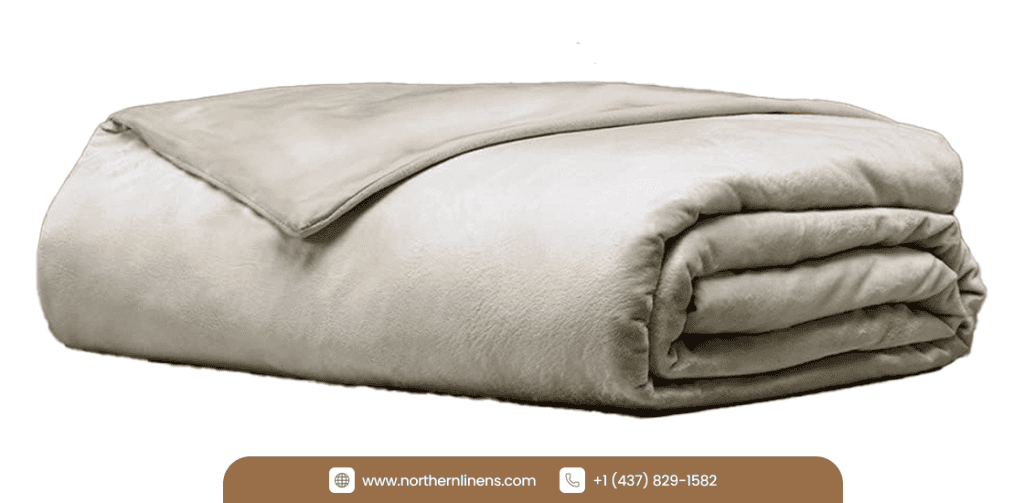
If you are adding weighted blankets to a hotel, a spa or a care facility, three questions arrive before the first guest does. How do you launder it between users, whose body weight is the blanket sized for, and who decides which guest or resident is allowed to use it. Wholesale weighted blankets bought for a property in Toronto, a spa in Mississauga or a residence in Vancouver have to answer all three before the price is discussed. Each answer is a specification, and the specification is what you are buying. The guide below covers the specification that holds up to commercial laundering and the weight and safety rules for each facility type. Then it covers how you sample, price and order in bulk. Specify the Fill, the Cover and the Construction Before the Weight The weight is the number on the label. The fill, the cover and the stitching decide whether the blanket keeps that weight evenly distributed after fifty of your washes. Those three come first. Glass Beads or Plastic Pellets The weight comes from beads sewn into quilted pockets. Glass microbeads are denser, so the blanket is thinner and quieter and runs cooler. Plastic pellets are bulkier, need more batting to mask their feel, and sleep warmer. For a commercial buyer the difference is in the laundry. Glass beads tolerate hot washes and tumble drying that some pellets do not, and a thinner blanket dries faster and takes less space on a housekeeping cart. Fill Weight per volume Feel and sound Heat Laundering Glass microbeads High, thin profile Sand-like, silent Cooler Withstands hot wash and tumble drying Plastic poly pellets Lower, thicker profile Grainy, audible Warmer Check the pellet’s heat tolerance before hot washing Knitted, no fill Weight from the yarn itself Open knit, silent Cooler Washes like a heavy blanket, longer dry time Pocket Size and Stitching Even distribution depends on the pocket. Pockets of roughly four to five inches keep the beads from migrating to one corner when the blanket is folded, carried or washed. Each pocket has to be closed with its own stitching rather than relying on the quilting line. The outer seams need a double stitch, because a burst seam on a 15-pound blanket empties beads into your washer drum. A bead-free knitted weighted blanket avoids the pocket question entirely and suits properties where a leak is unacceptable. The Removable Cover A commercial weighted blanket has two parts. The inner weighted blanket carries the beads and is laundered on a schedule. The removable cover is what the guest or patient touches and is laundered between users, the way a duvet cover is. The cover needs a closure that survives industrial processing and ties or loops at the corners so the inner blanket stays put. The same closure rules that apply to percale duvet covers in spas and wellness facilities apply here, and the same cover fabrics are used. Inner blanket: quilted pockets, glass or pellet fill, laundered on a monthly or quarterly schedule Cover: cotton, bamboo viscose or a minky-style polyester, laundered between users Closure: hidden zipper or button placket, with corner ties to hold the inner blanket Certification: OEKO-TEX on the cover fabric, with the certificate supplied for the compliance file Our covers and inner blankets are supplied separately or as a set. You can hold more covers than blankets and keep the blankets in service while the covers turn. Request a quote for either through the Blankets and Throws category or from the weighted blanket product page [INTERNAL LINK: weighted blanket product page]. Match the Weight and the User to Each Facility The consumer rule is that a weighted blanket weighs about 10 percent of the user’s body weight. You do not know who will use yours. The weight is therefore chosen for your facility’s population and the use case, and the safety rules are written into the procedure that goes with the blanket. The Weight Rule and Its Limits Ten percent of body weight is a comfort guideline rather than a safety limit, and anything over 15 percent is treated as too heavy. Weighted blankets are not for infants or children under three. They are not for anyone who cannot remove the blanket unaided, or who has a respiratory, circulatory or mobility condition, without a clinician’s agreement. For a commercial buyer those rules translate into a weight range and a written procedure. Facility Typical weight Size Who uses it Procedure Hotel guest room or pillow menu 12 to 15 lb 48 by 72 inch throw Adult guests on request Offered, not placed; care card in the room Spa and wellness treatment 10 to 15 lb Throw sized to the table Adult clients during a treatment Placed by the therapist, removed at the end Retirement and senior living 5 to 10 lb Lap or throw Residents assessed by staff Staff-issued, removable by the resident Healthcare and hospital 5 to 12 lb Per unit policy Patients under a care plan Prescribed, documented, supervised Hotels and Inns A hotel offers the blanket rather than placing it on the bed. A 12 to 15 pound throw in a neutral cover suits most adult guests. A care card in the room states the weight, who it is not for, and how to request a different weight. The blanket sits on your pillow menu or amenity list. Housekeeping changes the cover between guests and launders the inner blanket on the same cycle as the duvet inner. A Toronto property with 100 rooms rarely needs 100 blankets. A stock of 10 to 20 with 40 covers serves your requests. Spas and Wellness Facilities A spa uses the blanket for the treatment, not the night, so the weight can sit at the lighter end and the cover has to change with every client. The blanket is placed by the therapist and removed at the end of the session, which resolves the safety question, and the cover is laundered with the treatment linens. A cotton or bamboo

How to Choose Wholesale Percale Sheet Sets for Healthcare & Hospitals
Bedding

How to Choose Wholesale Percale Sheet Sets for Healthcare & Hospitals

Wholesale percale sheets are a fabric construction rather than a clinical approval. Percale describes a plain weave. Whether a given sheet set suits a patient bed, a long-term care room or staff accommodation depends on the facility’s own requirements and the product’s documented specification. Wholesale percale sheets are bought by healthcare procurement teams for a wider range of uses than the term suggests, and percale itself guarantees none of them. It describes a plain weave, one thread over and one under, which produces a crisp matte fabric. It says nothing about whether a product is appropriate for a particular bed in a particular facility. That boundary is where healthcare buying differs from hospitality buying. A hotel dresses one kind of room. A hospital covers patient beds, long-term care rooms, staff accommodation and family suites, each with its own requirements and often its own bed dimensions. This guide covers where percale sits among bedding categories and how to map bed populations before specifying. It then looks at what healthcare laundering does to fabric, the documentation procurement will need, and how to test and reorder. Percale Is A Weave, Not An Approval Four categories of bedding are sold into institutional settings, and wholesale percale sheet sets can belong to more than one of them depending on how the product is specified. They are not interchangeable. Category Built for Typical use General commercial bedding Repeated industrial laundering Offices, residences, institutional accommodation Hospitality bedding Presentation plus commercial laundering Hotels, guest rooms, staff quarters Healthcare general-use bedding Frequent processing under facility programmes Non-clinical areas, long-term care rooms Specialised clinical textiles Defined performance requirements Applications governed by facility or regulatory specification A percale sheet set sits in the first three categories depending on how it is specified. Whether it belongs in the fourth is a question for the facility’s own requirements and the product’s documentation, not for a weave description. Info: Ask a supplier which category their product is specified for, and ask for the documentation supporting it. A supplier who answers with fabric qualities rather than with a specification is describing the material rather than its intended application. Map The Facility’s Bed Populations First Specifying one set of wholesale percale sheets across a healthcare site is the most common procurement error, because the beds themselves differ before anything else does. Bed Dimensions Vary More Than In Hospitality Hospital and care bed mattresses are commonly narrower and longer than domestic sizes, and dimensions differ between manufacturers. Pressure-redistribution mattresses and overlays add depth on top of that, which changes what a fitted sheet needs to accommodate. Measure the beds you actually own rather than ordering to a nominal size. A facility that replaced beds in one wing three years ago will often find two or three configurations in service. Different Populations, Different Requirements Patient beds carry the facility’s own requirements, which govern whatever a supplier says about the fabric Long-term care rooms sit closer to residential comfort, with heavy laundering and frequent changes Staff accommodation behaves like hospitality bedding with a lower presentation demand Family and guest suites are judged on comfort and appearance by people already under strain Ordering one specification for all four means one population is served correctly and the others are compromised in different directions. What Healthcare Laundering Does To Fabric Facility laundry programmes are harder on wholesale percale sheets and on every other textile than hospitality programmes are. Wash temperatures run higher, chemistry is stronger, and items cycle more frequently, all of which shortens the life of any sheet regardless of its construction. That changes which specifications matter. Wash tolerance, shrinkage allowance and seam strength predict how long a product lasts here far better than thread count does. Establish three figures in writing before comparing quotes. Maximum wash and dry temperatures for the specific fabric What bleach and chemistry the fabric tolerates Finished dimensions measured after laundering, with a stated shrinkage allowance Note: Confirm those figures against what your laundry actually runs rather than what its policy states. An off-site provider running a single programme for all linen will not adjust it for one product line, which makes their programme the constraint on your specification. Documentation Procurement Will Need Healthcare purchasing carries paperwork requirements, but hospitality does not, and the time to establish what a supplier of wholesale percale sheet sets can provide is before an order rather than during an audit. Ask any supplier what they can provide for the specific product. Fibre content as it appears on the label, with the composition stated exactly Any certifications held, and which products each one covers Test documentation supporting claims made about the fabric Confirmation of whether the product is intended for patient beds, general facility use, or accommodation Whether an approved specification is retained and future production checked against it That last point carries more weight in healthcare than elsewhere. A facility reordering over several years needs later deliveries to match the approved reference, and a supplier who cannot confirm that is offering a product rather than a supply arrangement. Testing And Reordering Wholesale Percale Sheet Sets Two practical steps decide whether a bulk order of wholesale percale sheets works out. Run A Sample Through Your Own Laundry Request enough sets to dress a small number of beds, then process them through your actual programme at its normal settings. Run at least twenty cycles before judging, since most fabrics survive the first few regardless of quality. Measure shrinkage against the quoted finished dimensions, check fit on the beds afterwards, inspect seams and hems, and compare colour against an unwashed set kept aside. Settle Ordering Terms Before The First Purchase Ask what the minimum order quantity is per size rather than per order, and ask separately what applies on a reorder. Facilities replace in smaller quantities than they buy initially, and a supplier whose reorder minimum matches the first order is a poor fit for replenishment. Confirm where stock is held and what the lead time is from that location, and whether

How to Choose Wholesale Bamboo Sheet Sets for Boutique & Luxury Hospitality
Bedding

How to Choose Wholesale Bamboo Sheet Sets for Boutique & Luxury Hospitality

Wholesale bamboo sheet sets are bought in volume at a trade price, which says nothing about whether the product was built for commercial laundering. Many bamboo sets offered to hospitality buyers are retail constructions sold in bulk, so the question to ask is how the fabric was specified. Wholesale bamboo sheet sets are sold at a trade price in trade quantities, and neither of those facts tells a hospitality buyer whether the product will survive their laundry. Wholesale describes how something is bought. It does not describe how the fabric was specified, and plenty of bamboo sets reaching hospitality buyers are retail constructions moved in bulk. That distinction matters more for boutique and luxury properties than for anyone else, because the feel guests notice comes from the same fabric characteristics a commercial laundry treats worst. This guide covers what wholesale actually guarantees and how guest experience and laundry requirements pull against each other. It then sets out what to confirm about the fabric, how to order and replenish across a portfolio, and what to test before committing. Wholesale Is A Price And A Quantity, Not A Specification Three different things get described as wholesale bamboo sheet sets or wholesale bedding, and only one is engineered for repeated commercial processing. Category Built for What to watch Consumer bedding Domestic washing, occasional use Sold in bulk by some suppliers without any change to the construction Wholesale bedding Trade purchasing at volume Describes the channel and the price, not the fabric Commercial bedding Repeated industrial laundering Specified for wash tolerance, shrinkage control and reorder consistency A retail product bought at trade price is still a retail product. It may feel excellent on delivery and thin out within a season of commercial washing, and the buyer discovers that after the whole property is dressed in it. Info: Ask a supplier directly whether the product is specified for commercial laundering, and what that specification actually says. A supplier selling into hospitality will have an answer. One who treats the question as unusual is selling a retail line through a trade channel. Guest Experience And Laundry Requirements Pull Against Each Other Boutique and luxury properties sell a feel, and wholesale bamboo sheet sets deliver one guests notice and mention. Softness, drape and the way the fabric moves moisture away from skin all contribute to what a guest reads as cooling. What Cooling Actually Means To A Guest Cooling is an experience rather than a property of the fibre working alone. Fabric composition, weave, fabric weight and how quickly moisture leaves the skin all contribute, and so does the room. A sheet will not compensate for warm air or uneven air conditioning, so treat cooling as one element of the guest experience rather than a claim to lean on. Why The Same Qualities Create An Operational Problem Fine, soft, fluid fabrics are handled harder by industrial laundries than sturdier constructions, and that applies to any premium bedding rather than to bamboo specifically. A property changing bedding daily puts a set through far more cycles than a household does in years. The realistic response is placement rather than compromise. Many boutique operators put the premium specification in suites and signature rooms where guests notice it most, and a harder-wearing specification in standard inventory. That keeps the positioning where it earns revenue without exposing the whole property to the replacement cycle. What To Confirm About The Fabric Establish these before comparing prices, since two quotes for wholesale bamboo sheet sets described the same way can differ substantially. The exact fibre description as it appears on the label, which for bamboo-derived fabric is normally expressed as viscose Whether the fabric is entirely bamboo-derived or blended, and in what proportion The weave, since percale and sateen behave differently in both feel and wear Fabric weight in GSM, which indicates durability better than thread count does Finished dimensions measured after laundering, with a stated shrinkage allowance Maximum wash and dry temperatures, and what bleach the fabric tolerates Any certification held, and which products it covers Our guide on cooling bamboo sheet sets for Canadian motels covers the laundering behaviour of bamboo viscose in detail, including wash chemistry and where a blend outperforms the pure fibre. Note: Confirm the fibre content in writing before any marketing material describes the product to guests. Labelling rules govern how the fabric must be identified, and a property repeating a supplier’s looser description takes that on itself. Ordering And Replenishing Across A Portfolio Boutique groups, vacation rental operators and property managers reorder wholesale bamboo sheet sets in patterns that differ from a single large hotel, and the terms matter as much as the product. Minimum Quantities And Reorder Flexibility Ask what the minimum order quantity is per size and colour rather than per order. A low overall minimum spread across four sizes and three colours is not a low commitment. Then ask what the minimum is on a reorder, since replacing two sets in one property is a different transaction from dressing a building. Operators running short-term rentals replace in small, irregular quantities and need a supplier who accepts that. Consistency Between Orders Stock bought over several years enters service alongside older stock, so a shade difference between production runs shows up on adjacent beds. Ask whether an approved specification is retained between orders, whether shade is checked against that reference, and whether one production run can cover a property’s full requirement. Property managers standardising across a portfolio should resist applying one specification everywhere. Properties differ in positioning, laundry arrangements and budget, and a specification suiting a boutique hotel may be wrong for a serviced apartment in the same portfolio. Supply And Delivery Ask where stock is held, what the reorder lead time is from that location, and whether the item is stocked or made to order. For an operator in Brampton, or running properties across Vaughan, Markham and Richmond Hill, confirm the schedule against your own order rather than a general figure. Test Before The

How to Choose Wholesale Egyptian Cotton Sheet Sets for Assisted Living & Group Homes
Bedding

How to Choose Wholesale Egyptian Cotton Sheet Sets for Assisted Living & Group Homes

Wholesale Egyptian cotton sheets suit some rooms in an assisted living residence and waste money in others. The facility type does not decide it. What decides it is how each room’s bedding is soiled and laundered, which varies between residents inside the same building. Wholesale Egyptian cotton sheets are usually specified by facility type, and that is the wrong unit of decision. Two rooms in one assisted living residence can generate completely different laundry loads, because the residents in them need different levels of support. A premium sheet set in the first room earns its price and in the second one is washed to death inside a year. Group homes add a second problem, which is buying in quantities the wholesale market is not built around. This guide covers segmenting rooms by their actual laundry profile, verifying the fibre claim before paying for it, how small and distributed properties should approach ordering, counting the sizes already in service, and approving a sample before dressing a building. The Facility Name Does Not Set The Specification Assisted living covers a wide span. Some residences operate close to residential accommodation with hospitality-style laundry. Others support residents with higher needs, where bedding is changed more often and washed harder. Both can appear under the same name on the same site, which is why the useful unit is the room rather than the building. Room profile Laundry pattern Premium specification Independent resident, occasional assistance Scheduled changes, moderate temperatures Usually earns its cost Resident with regular personal care More frequent changes, warmer wash Depends on the wash programme Higher soiling or clinical involvement Frequent changes, hot wash, stronger chemistry Rarely the right place for premium cotton Shared and guest rooms Light use, presentation matters Often the best value for premium stock Walk the building and assign each room a profile before requesting quotes. Operators frequently find the split is not what they assumed, and that the rooms where a premium sheet would be noticed are not the rooms where it would survive. Info: Ask your laundry what programme each category of linen actually runs on. Where an operator uses an off-site provider running one programme for everything, that programme is the real constraint on any specification you buy. Verify The Fibre Claim Before Paying For It Egyptian cotton names a growing region rather than a grade. The property buyers are paying for is extra-long-staple fibre, which produces smoother, stronger yarn, and not every product described as Egyptian cotton contains it. Ask for the fibre content exactly as it appears on the product label, ask what verification the supplier holds, and ask what that verification covers. Canadian labelling rules govern how fibre content must be stated, and a facility repeating a looser description in its own material takes that on itself. Small And Distributed Properties Buy Differently Group homes and small residences are not scaled-down versions of large facilities. The wholesale market is built around volume, and that creates three problems a two-hundred-bed operator never encounters. Minimum Quantities Are Set Per Size And Colour A minimum order quantity quoted as a single figure sounds manageable until it applies to each size and each colour separately. A six-bed house needing two sizes and one colour can find the smallest available order covering its entire linen requirement several times over. Ask for the minimum per size and colour, and ask what applies on a reorder. Replacing four sets is a different transaction from an initial order, and a supplier whose reorder minimum matches their opening minimum is a poor fit for a small property. A Bad Order Dresses The Whole House A large facility trialling a new specification in one wing can absorb a mistake. A group home ordering for every bed at once cannot, which makes sample approval more important here rather than less. Several Delivery Points, One Specification Operators running multiple houses order for several addresses against one approved specification. Confirm whether a supplier can split a single order across delivery points, and whether each house can reorder against the same reference without re-approving it. Count The Sizes Already In Service Beds in small residences are bought separately over years, so they rarely match. This is the most common cause of an order that arrives usable in some rooms and wrong in others. Measure Before Standardising Measure the mattresses in every room, including depth, because fitted sheet pocket depth is where mismatches show up first. Record what you find rather than trusting an inventory list, since replacements are often made without the paperwork following. Operators frequently discover two or three configurations across what they believed was one standard. That is not a failure of record keeping so much as the natural result of replacing beds one at a time. Reduce The Count Rather Than Matching It Ordering to every size found multiplies the stock you hold and the chance of the wrong sheet reaching the wrong room. The practical route is to order to the most common size, list the exceptions, and replace those beds first when capital allows. Note: Standardising beds does more for linen cost than standardising sheets does, because bed variety is the cause rather than the symptom. Where a replacement programme already exists, aligning it to one mattress size across a portfolio pays back through every future linen order. Approve A Sample Before The Rollout Request enough sets to dress two or three rooms, chosen from different room profiles, then put them into normal service. Run at least twenty wash cycles through your actual laundry at its normal settings. Most fabrics hold up through the first few regardless of quality, and the differences that matter show up later. Check four things at the end. Shrinkage measured against the quoted finished dimensions, then fit on the actual beds Surface condition, including pilling and any thinning at the fitted corners Colour against an unwashed set kept aside as a control How the sets handle for staff, since a sheet that takes longer to fit

How to Choose Commercial Duvet Covers for Canadian Laundry & Linen Rental Operations
Bedding

How to Choose Commercial Duvet Covers for Canadian Laundry & Linen Rental Operations

Commercial duvet covers bought for a rental or laundry programme are judged on processing cost per turn rather than unit price. A cover needing hand finishing costs labour on every cycle, and across hundreds of turns that recurring cost outweighs any difference in what the item cost to buy. Commercial duvet covers bought for a rental programme are a different purchase from covers bought for a property’s own rooms. The operator will process the item hundreds of times and then hand it to a customer whose standards they do not control. One product has to meet two sets of requirements. There is a terminology problem to settle first. In this trade the word linen describes flax fibre and also describes anything running through a commercial laundry, and the two carry very different care profiles. This guide covers that distinction and why the buyer is rarely the user. It then explains how processing cost per turn outweighs purchase price, what circulating stock needs to stay sortable, and what to confirm before an order. Establish What Linen Means In The Quote A supplier offering a linen duvet cover may mean one of two things, and the difference changes the care profile, the finishing and the price. Linen As A Fibre Flax linen is strong and breathable, and it takes moisture well. It also creases heavily and recovers poorly. A flax cover comes out of a laundry rumpled and stays that way unless pressed, and even then the finish does not hold. Flax tolerates repeated folding at the same crease poorly, which matters for stock that is folded identically and stored between rentals. Linen As A Trade Term Used the other way, linen simply means bedding processed through a commercial laundry, whatever it is made from. A quote using the word this way tells you nothing about fibre content, so ask for the composition in writing before comparing products. Info: Request the fibre content exactly as it appears on the product label rather than as it appears in a description. Those are not always the same, and the label governs what you can tell your own customers. The Buyer Is Rarely The User A hotel buying for its own rooms answers to itself. An operator buying commercial duvet covers for a rental programme answers to their processing floor and to every customer receiving the stock. Those two sets of requirements can pull in different directions. The processing floor wants an item running through washing, extraction, drying and finishing without special handling. The customer wants a cover their residents find comfortable and their staff find quick to change. Requirement Set by What to establish Wash and dry tolerance Your processing programme Maximum temperatures and bleach compatibility Finishing method Your equipment Whether it can run through your ironer or needs hand work Comfort and presentation Your customer What their residents or guests expect Sizing Your customer’s inserts Insert dimensions in their buildings, not yours Facility requirements Your customer’s setting Any specification their environment demands The last row matters most in care settings. Rehabilitation, hospice and nursing environments may carry requirements an operator cannot see from their own floor, and a cover described as premium does not automatically meet them. Confirm those with the customer. Processing Cost Per Turn Outweighs Unit Price Commercial duvet covers in a rental programme are processed again and again, so any handling they demand is paid for every single time. What Adds Cost On Every Cycle Covers that cannot run through a flatwork ironer and need hand finishing Fabrics that hold creases and need pressing to look acceptable Closures requiring a separate step to fasten or check before folding Items that tangle in washing and need separating by hand Stock needing sorting by size or customer because it cannot be told apart quickly Why This Changes The Comparison A modest difference in purchase price disappears against labour repeated hundreds of times. A cover costing slightly more that runs straight through the line returns that difference quickly, then keeps returning it. Put a figure on it during evaluation. Run samples through your own line, time any step performed by hand, then multiply by expected turns per year. Note: Ask a supplier whether the cover is designed to run through a flatwork ironer and what finishing method they expect. A supplier who has not considered that question is selling into retail rather than into rental. Rental Stock Has To Stay Sortable And Repeatable Commercial duvet covers circulating between customers create two problems a property buying for itself never encounters. Identification On The Sorting Floor Staff sorting at speed need to tell sizes and specifications apart without unfolding anything, because folded covers look alike. Coded stitching, woven labels or edge markers earn their cost in a rental operation for exactly that reason. Agree the coding system at the order stage and keep it consistent. A system that changes between production runs is worse than none, because staff apply the older one from memory. Shade And Specification Drift Between Orders Stock is bought in lots over years, so new items enter circulation beside older ones. A slight shade difference between production runs is invisible on a swatch and obvious on adjacent beds. Ask directly whether an approved specification is retained between orders, whether future production is checked against that reference, and whether a single run can cover a customer’s full par level. Those three answers decide whether the stock stays consistent as it ages. What To Confirm Before Placing The Order Several details about commercial duvet covers are straightforward to settle in advance and expensive to discover after delivery. Sizing Against The Customer’s Inserts Duvet covers are sized to the insert rather than the bed, and inserts vary between manufacturers. Collect the insert dimensions across your customers’ buildings before standardising, and ask what allowance the cover carries. Sample Testing Through Your Own Line Run samples through your actual programme at your actual settings, not the supplier’s recommended ones. Measure shrinkage, seam and closure condition,

How to Choose Percale Duvet Covers for Canadian Spas & Wellness Facilities
Bedding

How to Choose Percale Duvet Covers for Canadian Spas & Wellness Facilities

Percale duvet covers are chosen on closure design and changing time more than on the weave itself. The closure is where a cover fails first, and the time housekeeping spends fitting one multiplies across every room and every change, which usually outweighs the difference in unit price. Percale duvet covers are usually selected based on how the fabric feels in a sample, and that is the least useful test available to a facility buyer. A cover fails at its closure long before the fabric wears out, and the minutes housekeeping spends fitting an insert repeat in every room at every change. Percale is a reasonable starting point for properties wanting a crisp, matte, breathable presentation. Whether it suits yours depends on how the bedding is used, laundered and replaced. This guide covers what percale actually gives you and why the closure decides lifespan. It then looks at how changing time affects the real cost, what treatment oils do to the specification in spa settings, and what to confirm before placing a bulk order. What Percale Gives You, And What It Does Not Percale duvet covers start from a plain weave, one thread over and one under, producing a matte surface and a crisp hand. The structure has no long floats sitting on the face, so less yarn is exposed to abrasion from handling and industrial washing than in a sateen of comparable quality. For a spa or wellness property that reads as a presentation choice. Percale looks fresh on a made bed and holds a press, which suits properties selling calm and order, and it feels cooler than sateen in warm relaxation suites. What percale does not do is solve durability on its own. Yarn quality, fabric weight and finishing decide how a cover wears. Info: Ask for fabric weight in GSM alongside thread count. For duvet covers it is the better indicator, because a cover is handled, stuffed and pulled far harder than a flat sheet and the fabric carries that load. The Closure Decides How Long A Duvet Cover Lasts The closure gives out before the fabric does on almost every duvet cover, and the four common designs each fail in their own way. Closure How it fails Suits Buttons Threads work loose in industrial laundry, buttons detach and are lost Properties with in-house sewing capacity Ties Fray and snap, and staff skip tying them when rushed Lower-turnover settings Zip Teeth distort or the slider fails, usually ending the cover’s life Gentler laundry, lower change frequency Envelope or hotel flap No hardware to fail, though the insert can shift without internal ties High-turnover properties and care settings Why Hardware Is The Weak Point Anything mechanical goes through the same wash, extraction and drying cycle as the fabric, and it wears faster. A jammed zip makes a cover unusable while the fabric is still sound, and few laundries repair them. Envelope closures avoid hardware entirely, which is why they dominate hospitality and care settings. The trade is that without internal corner ties the insert migrates inside the cover. Ask What Can Be Repaired Find out which failures a supplier expects and whether any can be fixed rather than replaced. A detached button is repairable in a property with a sewing machine. A failed zip usually is not. Changing Time Is The Cost Nobody Quotes Percale duvet covers take considerably longer to change than a flat sheet, and that difference repeats in every room at every changeover. Across a season it can exceed the difference in unit price between two products. Three design features affect how long a change takes. Internal corner ties hold the insert in position, so housekeeping fits it once rather than redistributing filling every change Opening width determines whether an insert can be fed in from the end or has to be fought through a narrow gap Fabric slip affects how easily the insert slides into place, and a very crisp finish can grip rather than glide Ask whether corner ties are included as standard, since they are frequently an option rather than a default. On a property changing bedding daily, they pay for themselves in labour long before the cover wears out. Note: Time a change during your sample trial. Have housekeeping fit two or three covers and record how long each takes, then multiply by your rooms and your change frequency. That figure is usually more decisive than the quoted price. Setting-Specific Requirements Percale duvet covers do not carry one specification across every environment, and spa properties in particular face a demand that hospitality does not. Treatment Oils In Spa And Wellness Settings Massage and body oils transfer readily to bedding and resist ordinary washing. Residue then builds up over repeated cycles. It affects colour retention and can leave fabric feeling weighted rather than crisp. Oil-contaminated linen needs careful laundry handling, which is worth raising with your laundry provider rather than assuming a standard programme copes. Where covers sit in or near treatment areas rather than overnight rooms, discuss both the fabric specification and the wash process with your supplier before ordering. Some properties keep separate stock for treatment areas and guest rooms, replacing the treatment-area covers on a shorter cycle. Long-Term Care And Senior Living Requirements differ across care levels, and assuming one cover suits all of them is the common error. Setting What tends to matter most Independent living and retirement suites Presentation and comfort, laundry closer to hospitality Assisted living Ease of changing, varied bed sizes across rooms Long-term and nursing care Wash tolerance, frequent changes, straightforward replacement Group homes Mixed bed types, flexible order quantities Bed sizes are rarely uniform in assisted living and group homes, so establish what is in the building before standardising on one size. What To Confirm Before A Bulk Order Several practical details decide whether an order of percale duvet covers arrives usable, and each is easier to settle in advance than afterwards. Size The Cover To The Insert Duvet covers are sized to

How to Choose Premium Cotton Sheet Sets for Canadian Retailers & Bedding Stores
Bedding

How to Choose Premium Cotton Sheet Sets for Canadian Retailers & Bedding Stores

Retail buyers should specify cotton sheets against the things that cause returns: pocket depth, shrinkage, pilling and colour variation between orders. Fibre and weave decide how a set feels, but fit and dimensional stability decide whether it comes back, and returns cost more than specification upgrades. A retail buyer purchasing cotton sheets is not buying a fabric. They are buying a returns rate, a review score and a reorder relationship, and the specification decisions that drive those three are not always the ones suppliers lead with. A set can feel excellent in a showroom and still generate complaints, because the customer discovers after two washes that it no longer fits their mattress. Fibre and weave shape how a product feels and how it is positioned on a shelf. Fit, dimensional stability and lot-to-lot consistency decide whether it stays sold and whether a second order is worth placing. This guide covers specifying against the causes of returns, how to handle thread count as a merchandising problem rather than a quality one, building an assortment without a SKU explosion, working out landed cost instead of unit cost, meeting Canadian labelling requirements, and sampling before a first order. What A Retail Buyer Is Actually Purchasing Every other reader of a bedding specification will sleep on the product. A retail buyer will not, which changes what the specification needs to protect against. A hotel discovers a weak sheet through its own laundry over months, and absorbs the result quietly. A retailer discovers it through a customer who washed the set twice, found it no longer fits the bed, posted a two-star review and asked for a refund. The cost arrives faster, publicly, and with shipping attached. That shifts the priority order. Softness and hand-feel sell the first unit. Dimensional stability, fit and consistency determine whether the product keeps selling and whether the second order is worth placing. Specify for the second one. Specifying Against The Causes Of Returns Bedding returns cluster around a small number of causes, and all of them can be addressed at the specification stage rather than the customer service stage. Pocket Depth And Fit Fit is the largest single driver of bedding returns. Mattress depths vary widely, and toppers and protectors add more. A customer whose fitted sheet will not stay on the corners returns it, and no amount of fabric quality prevents that. Two decisions follow. Specify a pocket depth generous enough for the mattresses your customers actually own, including a topper, and state that depth prominently on the packaging rather than burying it in the specification panel. A stated depth converts a return into a purchase decision the customer made correctly. Where a range serves two very different mattress populations, a second depth option is worth the extra SKUs. Shrinkage A set that fits at first wash and not at the fifth generates a delayed return and a poor review, and the customer blames the product rather than the laundering. Ask suppliers for finished dimensions measured after laundering, not before, along with a stated shrinkage allowance over a defined number of washes. Compacted or pre-shrunk finishes reduce cumulative shrinkage. A supplier quoting cut dimensions without a shrinkage figure has left the risk with you. Pilling Pilling appears after several washes, which places it squarely in review territory rather than return territory, and reviews carry further than a single refund. The property that governs it is staple length. Long-staple and extra-long-staple cotton spin into yarn with fewer fibre ends protruding from the surface, and it is those ends that migrate and tangle into pills. Short-staple cotton pills regardless of thread count or finish. Specify staple classification rather than accepting a general claim about cotton quality. Our guide to Egyptian cotton sheet sets covers why origin names and staple length are not the same thing. Colour Variation Between Orders A customer buying a matching pillowcase six months later, or a retailer receiving a reorder that sits on the shelf beside existing stock, will see a shade difference that looked negligible on a swatch. Ask directly how lot-to-lot variation is controlled, whether an approved specification is retained between orders, and whether a single production run can cover an initial buy. This is the failure most likely to affect a repeat customer, who is also the one worth keeping. Thread Count Is A Merchandising Problem, Not A Quality One Retail buyers face a version of this question that institutional buyers do not, because the number is printed on the box and the customer compares it on the shelf. How High Counts Are Produced A yarn can be spun as a single strand or as two or more finer strands twisted together. Where a fabric is woven from multi-ply yarn, some suppliers count each ply, so a fabric with 300 actual threads per inch is advertised at 900. The inflated fabric is not better. Finer plies twisted together are weaker than one thicker single-ply yarn of equivalent mass, and densely woven fine yarns trap heat, which produces the complaint that expensive sheets sleep hot. The Position Retailers Are Put In A store stocking an honest 400-count product next to a competitor’s 1800-count product is losing a comparison the customer is making on the only number they understand. There are two ways out and both are legitimate. Compete on the number, accept that the product is comparable or worse, and price accordingly. Or reframe the comparison on the packaging and at the point of sale, leading with staple length and single-ply construction and treating thread count as one specification among several. The second route needs support. Staff have to be able to explain it in a sentence, and the packaging has to carry it. A retailer who chooses the honest product without changing how it is presented will lose the sale and conclude the product was wrong. What To Ask Every Supplier What is the thread count, and is the yarn single-ply or multi-ply? What is the staple classification of cotton? What is

How to Choose Premium Linen Sheet Sets for Canadian Student Housing & Residences
Bedding

How to Choose Premium Linen Sheet Sets for Canadian Student Housing & Residences

Premium linen suits student accommodation where bedding is professionally laundered and the residence competes on quality. Where students wash their own sheets in shared machines, linen’s care requirements are rarely met and a cotton specification usually returns more. The laundry model decides this, not the room type. Premium linen belongs in some student accommodation and not in most of it. Where a residence launders bedding professionally and markets itself on quality, linen delivers breathability, longevity and a look that photographs well for recruitment. Where students wash their own sheets in shared coin-operated machines on whatever cycle is free, the care linen needs is not going to happen, and the premium buys little that survives the first term. The decision therefore turns on who does the laundry, not on what the building is called. This guide covers how the laundry model shapes the specification, what premium actually means in linen, where flax outperforms cotton and where it does not, getting Twin XL sizing and pocket depth right, and how to run a pilot before committing across a residence. Property managers and institutional buyers outside campus housing will find the same logic applies to any high-turnover accommodation. The Laundry Model Decides The Specification Student accommodation covers three very different operations, and the same building can contain more than one. Establish which applies before comparing fabrics. Students Launder Their Own Bedding Common in traditional residence halls where students bring or are issued sheets and wash them in shared machines. Cycles are chosen by whoever is in a hurry, temperatures and detergents vary, and nothing is sorted by fabric. Linen’s longevity depends on being washed and dried gently. In this environment that will not happen consistently, and specifying premium linen means paying for a property the operation cannot protect. A durable cotton or cotton blend is the better use of the budget. The Residence Launders Centrally Furnished private student accommodation, serviced student apartments and residences with in-house housekeeping run a controlled laundry. Programs can be set, fabric can be sorted, and temperatures are known. This is where linen works. The operation can meet the care requirements, and the durability that flax offers under gentle handling starts to show up as a longer replacement cycle. The Residence Operates As Accommodation Out Of Term Many Canadian universities run summer conference, visitor and event accommodation in their residences. Those weeks are a hospitality operation with hospitality expectations, professional laundering and a guest paying a nightly rate. Linen is a strong fit for this stock specifically. Residences frequently hold a separate, better specification for summer rooms, and treating that as a distinct linen program rather than an upgrade to the whole building is usually the more affordable route to a premium offer. Operation Specification that usually fits Students launder their own bedding Durable cotton or cotton blend Central housekeeping, in-house laundry Premium linen viable Outsourced laundry running one program Confirm the program before specifying linen Summer conference and visitor rooms Premium linen Graduate, faculty and guest suites Premium linen Show suites and recruitment tour rooms Premium linen, small quantity Info: Ask the laundry provider, in-house or contracted, whether they can run a separate program for one linen stream and what it costs. If the answer is no, the most demanding stream sets the specification for the whole building. What Premium Means In Linen Linen is graded differently from cotton, and buyers applying cotton logic to it will compare the wrong numbers. Fabric Weight, Not Thread Count Thread count is not a useful measure for linen. Flax yarns are thicker and less uniform than cotton yarns, so a count that would indicate a coarse cotton describes a sound linen. The figure to compare is GSM, grams per square metre, which measures how much fibre is actually in the fabric. Linen sheeting commonly falls between 150 and 200 GSM. Lighter fabrics feel airier and wear through sooner. Heavier fabrics last longer and take more energy to dry, which matters at institutional volume. Rather than treating any figure as correct, ask each supplier for GSM and compare like for like, then judge the samples against the rooms they are going into. Fibre Origin And Certification European Flax certification traces fibre to flax grown in Western Europe under defined agricultural standards. It verifies origin and growing practice rather than finished fabric quality, which is a meaningful distinction when comparing quotes. OEKO-TEX Standard 100 tests the finished textile for substances harmful to health. The two certifications answer different questions and a supplier may hold one, both or neither. Stonewashed Or Raw Raw linen leaves the loom stiff and needs repeated washing, commonly cited as 10 to 15 cycles, before it softens into something a resident would describe as comfortable. Stonewashed or pre-softened linen has been through that process at the mill and arrives soft. For any accommodation putting sheets straight into service, stonewashed is the practical choice. Raw linen delivered to a residence in August will feel unpleasant through the first weeks of term, which is precisely when new residents form an impression of the room. Where Linen Outperforms Cotton, And Where It Does Not Buyers are often told linen is more durable than cotton without qualification. The reality is more specific and worth understanding before a large order. What Flax Does Well Breathability and moisture handling. Linen moves moisture quickly and dries fast, which suits rooms with limited ventilation or inconsistent heating. Wet strength. Flax is strong and, like cotton, does not weaken when saturated, so washing itself is not what damages it. Longevity under gentle care. Linen that is washed and dried appropriately keeps its integrity for a long time and softens rather than degrading. Appearance. The texture reads as considered and photographs well, which matters for recruitment material and viewings. Where Cotton Is The Safer Choice Repeated creasing. Flax fibres resist abrasion well across a surface but tolerate repeated folding at the same crease poorly. Par stock folded identically and stored for months develops weakness along those lines. High-heat

How to Choose Premium Egyptian Cotton Sheet Sets for Canadian Senior Living
Bedding

How to Choose Premium Egyptian Cotton Sheet Sets for Canadian Senior Living

Premium Egyptian cotton suits independent and assisted living suites, where laundry is gentler and comfort drives resident satisfaction. Long-term care rooms with barrier washing and heavy soiling need a harder-wearing specification. Match the fabric to the care level rather than to the facility. Premium Egyptian cotton is the right choice for some rooms in a senior living facility and the wrong one for others. In independent living suites and retirement residences, where laundry is closer to hospitality than to healthcare, it delivers comfort residents notice daily. In long-term care rooms running barrier washing at high temperature with frequent soiling, fine premium yarns wear out fast and the money is better spent elsewhere. Bedding in senior living also carries requirements hospitality does not. Therapeutic mattresses lose effectiveness when too many layers sit between the resident and the support surface. Adjustable beds change shape under the sheet. Skin on older residents is more fragile, and how a fabric handles friction and moisture has clinical consequences. This guide covers matching the specification to the care level, what Egyptian cotton actually guarantees, choosing thread count and weave for institutional laundry, fitting therapeutic and adjustable beds, and buying consistently across facilities. Match The Specification To The Care Level, Not The Facility Most senior living operators buy one bedding specification for a whole building. That is the decision worth revisiting, because a single site can contain three very different laundry and soiling environments. Independent Living And Retirement Residences Residents here are largely self-sufficient, linen changes run on a hospitality-style schedule, and soiling is comparable to a hotel. Laundry is typically standard commercial washing rather than infection-control washing. This is where premium Egyptian cotton earns its cost. Residents live in these rooms for years and notice the bedding every night, and comfort contributes directly to satisfaction and to how families judge a residence during a tour. Assisted Living A middle case. Linen changes are more frequent, some soiling occurs, and laundry may run hotter with more bleach. Premium cotton still works, though specifying a slightly heavier fabric and a more durable construction will extend replacement cycles. Long-Term And Complex Care Frequent soiling, barrier washing, high wash temperatures and chlorine bleach are routine. Fine yarns woven at high thread counts break down quickly under those conditions, however good the fibre. Specifying premium Egyptian cotton here means replacing sheets far sooner, and the residents least able to appreciate the difference in hand-feel are the ones whose linen takes the heaviest treatment. A durable mid-weight cotton or a poly-cotton blend usually delivers a lower cost per use and a better resident outcome, because worn thin sheets are replaced promptly rather than stretched to justify their price. Care environment Recommended specification Independent living suites Premium Egyptian cotton, sateen or percale by preference Retirement residence guest suites Premium Egyptian cotton Assisted living Premium cotton, heavier weight, reinforced construction Long-term care Durable mid-weight cotton or poly-cotton blend Complex and memory care Durable blend, prioritising wash tolerance Respite and short-stay rooms Match to the laundry program, not the room type Info: Buying two specifications for one building sounds like an inventory complication and usually is not. Facilities already separate linen by floor or wing, and colour-coded hems or a different trim colour keep the two streams apart in the laundry. What Egyptian Cotton Actually Guarantees The term is used loosely across the bedding trade, and buyers paying a premium should know precisely what they are paying for. Origin Is Not Quality Egyptian cotton describes cotton grown in Egypt. That is all the name establishes on its own. Egypt produces several cotton varieties, and not all of them are the extra-long staple types that give the name its reputation. The property that matters is staple length, meaning the length of the individual cotton fibres. Extra-long staple fibre spins into smoother, stronger yarn with fewer fibre ends protruding from the surface, which is why it resists pilling and keeps its hand after repeated washing. Short-staple cotton pills within months in an institutional laundry regardless of where it was grown. Giza varieties are the extra-long staple cottons the reputation is built on. A supplier able to name the variety is telling you something specific. One who says only Egyptian is telling you about geography. Verifying The Claim Egyptian cotton is among the most widely misrepresented claims in bedding. The Cotton Egypt Association licenses use of the Egyptian Cotton trademark and operates DNA testing to verify fibre origin, and there have been significant cases of products sold as Egyptian cotton that were not. Ask any supplier for three things: The staple classification, extra-long staple or long staple, rather than the country alone Licensing or certification evidence for the Egyptian Cotton trademark, if the claim is being made Test documentation if a premium is being charged on the basis of fibre origin A supplier who manufactures in house can usually trace this. One buying finished goods from a third party often cannot, which is worth knowing before a premium is paid. Thread Count And Weave For Institutional Laundry Retail guidance on Egyptian cotton often recommends counts of 600 and above. That advice is written for a household washing machine and does not transfer to senior living. Why Very High Counts Underperform Here High thread counts are achieved by weaving finer yarns more densely, and finer yarns are individually weaker. In a facility laundry running high temperatures, chlorine bleach and frequent cycles, a densely woven fine fabric thins and tears sooner than a moderate count woven from heavier yarn. Dense fabrics also dry more slowly, which raises energy cost and tempts staff into longer drying cycles that abrade the fabric further. Counts advertised well above 400 are frequently inflated by counting individual plies within a yarn, a practice covered in our guide to hotel percale sheet sets. A single-ply fabric at a moderate count will normally outlast a multi-ply fabric advertised at double. Choosing The Weave Percale, a plain over-under weave, is matte, crisp and breathable. It suits residents

Scroll to Top

Get In Touch