
Thread count and GSM get thrown around interchangeably in linen marketing, but they measure completely different things and apply to completely different products. Thread count describes woven sheet density. GSM describes towel and robe weight and thickness. Confusing the two, or worse, treating either number as the single measure of quality, is one of the most common and most expensive mistakes in hotel textile procurement.
This guide breaks down what each metric actually measures, where the marketing claims stop matching reality, and what actually predicts whether a sheet or towel survives commercial reuse rather than falling apart after a few dozen wash cycles. For a broader look at how these specs fit into overall fabric selection, see our commercial hotel sheet fabric guide.
Thread Count vs. GSM: The Core Difference
Thread count applies to woven sheets and measures how many threads are woven into one square inch of fabric. GSM (grams per square meter) applies to towels, robes, and some heavier bedding, and measures fabric weight and density instead. They’re not interchangeable, and asking a towel supplier for “thread count” or a sheet supplier for “GSM” is usually a sign the conversation needs to be reset around the right metric for the product.
- Thread Count (TC): Counts the horizontal (weft) and vertical (warp) threads woven into one square inch of sheet fabric. Higher isn’t automatically better past a certain point.
- GSM: Measures the weight of towel or robe fabric per square meter, which directly correlates to thickness, absorbency, and how long the item takes to dry.
- Neither number tells you about fiber quality on its own. A high thread count made from cheap, short fibers can still feel and perform worse than a moderate thread count made from long-staple cotton.
Thread Count for Sheets: What the Number Actually Means
Thread count is a real, measurable spec, but it stops being a useful quality signal once you get much past the 400 to 500 range, because manufacturers can inflate the number using thinner, multi-ply threads without improving the fabric at all. For commercial hotel buying, that inflation risk matters more than it does for a one-off home purchase, since it directly affects your cost-per-durable-wash-cycle math across an entire property’s inventory. If you’re sourcing at scale, our bulk bedding supplier guide covers how to vet suppliers on exactly this kind of claim.
Where hotel-grade recommendations actually land, based on how commercial suppliers and buying guides describe the market:
- Several hospitality-focused sources put the commercial sweet spot around 200 to 300 TC for high-turnover operational efficiency.
- Others describe a broader 250 to 400 TC range as the reliable commercial zone, with mid-tier hotels commonly landing around 300 to 400 TC and upscale properties moving toward 400 to 600 TC.
- Consumer-facing testing sources (outside hospitality specifically) tend to recommend 300 to 500 TC as the best range for cotton sheets generally, noting that anything much above 500 isn’t reliably better.
The honest takeaway: there’s no single industry-agreed number, and you’ll see credible-looking sources recommend anywhere from 200 to 600+ TC depending on whether they’re writing for budget hotels, upscale hotels, or general consumers. What’s consistent across nearly every source is the warning about very high numbers, so treat “200 to 400 TC” as a safe, well-supported starting range for most commercial hotel use, and treat marketing claims above 600 to 800 TC with real skepticism until you’ve verified the fiber and weave. Our hotel bedding buying guide walks through how to weigh these ranges against your property’s positioning.
The Marketing Trap: Why 800+ Thread Count Isn’t What It Sounds Like
Thread counts above 500 to 600 frequently rely on multi-ply threads, meaning thinner, lower-quality fibers twisted together and each strand counted separately toward the total. This inflates the number on the label without actually improving the fabric, and can make it heavier, less breathable, and scratchier rather than more luxurious.
A simple way to think about it: two thin threads twisted together and counted as “2” contribute to a higher number than one strong single-ply thread counted as “1”, even though the single-ply version is often the stronger, more breathable fabric. This is exactly why you’ll see 1000+ thread count sheets marketed at budget prices online. A genuine 1000 single-ply thread count fabric would be extraordinarily expensive and impractically dense; most products advertised that high are multi-ply constructions.
What to check instead of trusting the number on the label:
- Ask the supplier directly whether the count is single-ply or multi-ply.
- Ask for staple length (long-staple or extra-long-staple cotton, like Supima or Egyptian varieties, produces stronger and smoother yarn regardless of the thread count number).
- Ask for the weave type, since percale and sateen perform differently at the same thread count.
Percale vs. Sateen: How Weave Changes the Equation
Weave type affects feel and durability at least as much as thread count does, which is why the same 300 TC fabric can perform completely differently depending on whether it’s woven as percale or sateen. Hotel buyers should treat weave as a primary spec, not an afterthought to thread count. Our percale sheets buying guide goes deeper into how this weave holds up specifically under commercial laundering.
| Weave | Feel | Typical TC Range Cited | Commercial Durability |
|---|---|---|---|
| Percale | Crisp, cool, matte finish | 200–400 TC | High; tight one-over-one weave resists pilling and snagging |
| Sateen | Silky, smooth, subtle sheen | 300–600 TC | Moderate; looser weave can pill faster under heavy laundering |
Percale is generally the stronger choice for high-turnover commercial laundering because of its tighter weave structure. Sateen offers a more luxurious guest-facing drape and sheen, which is why it shows up more often in upscale and luxury product lines, but it typically requires more careful laundering to avoid pilling over time.
GSM for Towels: What the Number Actually Predicts
GSM directly correlates with a towel’s thickness, absorbency, and how long it takes to dry in a commercial laundry cycle, which makes it a much more reliable single-number quality signal for towels than thread count is for sheets. Unlike thread count, GSM doesn’t have the same “multi-ply inflation” problem, since it’s a direct weight measurement rather than a woven thread tally. For a closer look at pairing towel weight with the rest of a bath program, see our wholesale bath linen guide.
| GSM Range | Weight | Best Use Case |
|---|---|---|
| 300–400 GSM | Light and thin | Gym towels, pool towels, fast turnover items |
| 400–600 GSM | Medium weight | Standard hotel bath towel sweet spot; absorbent and dries fast enough to control laundry utility costs |
| 600–900 GSM | Heavy and dense | Ultra-luxury feel, but holds water, dries slowly, and can develop odor if laundry turnover is slow |
The trade-off hotels need to actually plan around: heavier towels feel more luxurious to guests, but they take longer to dry in a commercial dryer, which increases utility cost per cycle and can create musty odor problems if your laundry turnover isn’t fast enough to keep up. A property with slower laundry turnaround should generally stay in the 400 to 600 GSM range rather than chasing the heaviest, most “luxurious” option, unless dryer capacity and turnaround time genuinely support it.
The Three Pillars of Commercial Textile Longevity
Thread count and GSM matter, but they’re not the only specs that determine whether hotel linens survive commercial laundering. Three additional construction details predict real-world durability at least as reliably as the headline numbers do.
- Ring-spun cotton construction. Ring-spinning tightly twists fibers together during yarn production, which reduces fraying and thinning through repeated commercial washing compared to looser open-end spinning methods.
- Polyester blends for sheets. A common commercial blend, roughly 60% cotton to 40% polyester, reduces wrinkling, speeds up drying time, and generally extends usable sheet lifespan compared to 100% cotton under aggressive industrial laundering, even though it gives up a small amount of natural-fiber breathability. Our microfibre vs. cotton bulk guide breaks down how these blends compare in real commercial use.
- Double-lock stitched hems. Reinforced stitching along sheet and towel edges prevents unraveling under the high heat and repeated agitation of commercial laundry cycles, which is often where wear shows up first, long before the body of the fabric itself fails.
Egyptian Cotton at Different Thread Counts: What Actually Changes
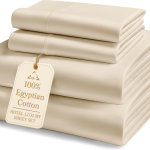
Egyptian cotton sheet sets are commonly sold at 400, 600, and 800 thread count, and the practical difference between them is mostly about weight and warmth rather than durability improving in a straight line with the number. Buyers choosing between these tiers should match the choice to guest comfort goals and climate rather than assuming higher always means better for commercial use.
- 400 TC: Lighter and more breathable, generally recommended for warmer climates or hot-sleeping guests, while still keeping a classic crisp-to-semi-soft touch.
- 600 TC: Frequently described as the balance point between softness, drape, and durability for year-round comfort, and is a common mid-tier hospitality choice.
- 800 TC: Noticeably heavier and denser, usually woven as sateen, giving a plush, warmer feel that some luxury properties use deliberately for a heavier-hotel-bed impression, at some cost to breathability.
Multiple hospitality-focused buying guides converge on roughly 400 to 600 TC as the practical sweet spot specifically for Egyptian cotton in commercial settings, with 800 TC treated as a deliberate luxury upgrade rather than a default recommendation. Some direct-to-consumer Egyptian cotton brands intentionally keep their thread count lower, in the 300 TC range, arguing that genuine long-staple fiber quality matters more than chasing a higher number, which reinforces the broader point that the fiber and construction behind the number matter as much as the number itself.
A Practical Framework for Evaluating Supplier Claims
Use this sequence when a supplier hands you a spec sheet, rather than reacting to the thread count or GSM number in isolation:
- Confirm the product category first. Thread count belongs to woven sheets; GSM belongs to towels, robes, and some heavier bedding. If a supplier quotes the wrong metric for the product, that’s a signal to ask more questions.
- Ask if thread count is single-ply or multi-ply, especially for any number above 500 to 600 TC.
- Ask for fiber staple length, since long-staple or extra-long-staple cotton (Egyptian, Pima, Supima) generally outperforms short-staple cotton at the same thread count.
- Ask for weave type (percale or sateen for sheets), since it affects both feel and commercial durability independent of the thread count number.
- For towels, confirm GSM and ask about drying time in your specific dryer setup, since heavier towels that feel luxurious can become an operational cost and odor problem if your laundry turnaround is slow.
- Ask about ring-spun construction and hem stitching, which affect longevity in ways neither thread count nor GSM directly captures.
- Request a sample and test it through your actual laundry process for at least 10 to 15 cycles before committing to a bulk order, since this is the only reliable way to verify durability claims against your specific laundry chemistry and heat settings.
Common Mistakes Hotel Buyers Make With These Metrics
- Chasing the highest thread count number available. Above roughly 500 to 600 TC, you’re often paying for multi-ply marketing inflation rather than genuine fabric quality.
- Ordering the heaviest GSM towels for a luxury feel without checking dryer capacity. Heavy towels that don’t fully dry in your laundry cycle create odor and hygiene issues that undercut the luxury impression you were going for.
- Treating thread count and GSM as interchangeable quality scores. They measure different things for different products; neither is a universal single-number quality signal.
- Ignoring weave type when comparing sheet options at the same thread count. A 300 TC percale and a 300 TC sateen will feel and wear differently under the same laundry conditions.
- Skipping a real-world laundry trial before a bulk order. Spec sheets describe the product as designed; only a wash-cycle trial in your own laundry conditions tells you how it will actually perform. Getting fit right matters too — see our deep pocket sheet fitting guide for how mattress depth interacts with fabric choice.
Why Fiber Source Matters More Than the Number on the Label
Thread count and GSM both describe construction, not fiber origin, which is why two products with identical specs can perform very differently once they’re in commercial rotation. The raw fiber going into the yarn, before it’s ever woven or measured, sets a ceiling on how good the finished fabric can realistically be.
- Extra-long-staple (ELS) cotton, including Egyptian and Supima/Pima varieties, uses longer individual fibers than standard upland cotton. Longer fibers produce smoother, stronger yarn with fewer loose fiber ends, which directly reduces pilling regardless of thread count.
- Standard short-staple cotton can still be woven into a perfectly serviceable commercial fabric, especially in a tight percale weave, but it generally won’t match ELS cotton’s smoothness or long-term pill resistance at the same thread count.
- Cotton-polyester blends trade a small amount of natural breathability for meaningfully better shrink resistance and wrinkle recovery, which is why blends remain common in commercial hospitality despite “100% cotton” often being perceived by guests as the more premium claim.
- Fiber source labeling isn’t always independently verified. “Egyptian cotton” has, in some parts of the retail market, been used loosely on packaging without full-chain verification of actual fiber origin. For a large commercial order, it’s reasonable to ask a supplier for documentation or certification behind an Egyptian cotton claim rather than accepting the label at face value.
Matching Thread Count and GSM to Your Property Tier
There isn’t one universal “correct” thread count or GSM for every hotel, since guest expectations, laundry intensity, and brand positioning all shift the right answer. Use property tier as a starting filter, then adjust based on your specific laundry setup.
| Property Tier | Sheet Thread Count Range Commonly Cited | Towel GSM Range | Reasoning |
|---|---|---|---|
| Budget / high-turnover | 200–300 TC | 300–400 GSM | Prioritizes fast drying, low laundry cost, and durability over plush feel |
| Mid-scale / select-service | 250–400 TC | 400–500 GSM | Balances guest comfort with operational efficiency |
| Upscale / full-service | 300–600 TC | 500–600 GSM | Leans toward guest-facing comfort while still respecting commercial laundry limits |
| Luxury / five-star | 400–800 TC (often sateen) | 600–900 GSM | Prioritizes plush, premium feel; requires faster laundry turnover to manage drying time and odor risk |
This table reflects the general pattern across the buying guides and hospitality sources referenced for this article, not a fixed industry standard. Treat it as a starting point for an RFP conversation with suppliers, not as a specification to copy without adjusting for your own laundry capacity and guest expectations.
Frequently Asked Questions
What is the best thread count for hotel sheets?
Most hospitality-focused sources recommend somewhere between 200 and 400 thread count for commercial hotel use, with high-turnover budget and mid-scale properties often landing around 200 to 300 TC and upscale properties moving toward 300 to 400 TC or higher. Sources vary on the exact ideal number, but nearly all agree that thread counts well above 500 to 600 don’t reliably improve quality and often signal multi-ply marketing inflation instead.
Is a higher thread count always better?
No. Past roughly 500 to 600 thread count, manufacturers frequently use thinner, multi-ply threads counted individually to inflate the number, which can make sheets heavier and less breathable without any real quality improvement. Fiber staple length and weave type are better predictors of true quality and durability than thread count alone.
What GSM is best for hotel towels?
A GSM range of 400 to 600 is generally considered the sweet spot for hotel bath towels, balancing absorbency and softness with a drying time that keeps commercial laundry utility costs manageable. Towels above 600 to 900 GSM feel more luxurious but dry more slowly and can develop odor problems if laundry turnover isn’t fast enough to keep up.
Does thread count apply to towels?
No. Thread count is a metric specific to woven sheets. Towels and robes are measured by GSM (grams per square meter) instead, since GSM captures fabric weight and thickness, which are more relevant to a towel’s absorbency and drying behavior than a thread count would be.
What’s the difference between percale and sateen weave for hotel sheets?
Percale uses a tight, one-over-one weave that produces a crisp, cool, matte feel and generally holds up better to aggressive commercial laundering. Sateen uses a looser weave with more thread floating on the surface, giving a smoother, silkier feel with a subtle sheen, but it can pill faster under heavy industrial wash cycles.
Is 800 or 1000 thread count better than 400 or 600 for hotel sheets?
Not necessarily. Many 800 and especially 1000+ thread count products on the market use multi-ply threads, which inflates the number without a proportional improvement in fiber quality or durability. Several hospitality buying guides specifically recommend staying in the 400 to 600 range for Egyptian cotton commercial sheets, treating 800 TC as a deliberate luxury choice rather than an automatic upgrade.
How do I know if a high thread count sheet is actually good quality?
Ask the supplier whether the thread count is single-ply or multi-ply, and ask for the fiber staple length, since long-staple or extra-long-staple cotton produces stronger, smoother yarn regardless of the thread count number. A moderate thread count made from quality long-staple fiber in a well-constructed weave will generally outperform a very high thread count made from short, multi-ply fibers.
Why do different sources recommend different ideal thread counts for hotel sheets?
Recommendations vary because sources differ in what property tier they’re addressing (budget versus luxury), whether they’re writing for hospitality buyers specifically or general consumers, and how they define “hotel quality.” Rather than looking for one universal number, hotel buyers get more reliable guidance by matching the range to their property tier and verifying fiber quality and weave type alongside the thread count itself.