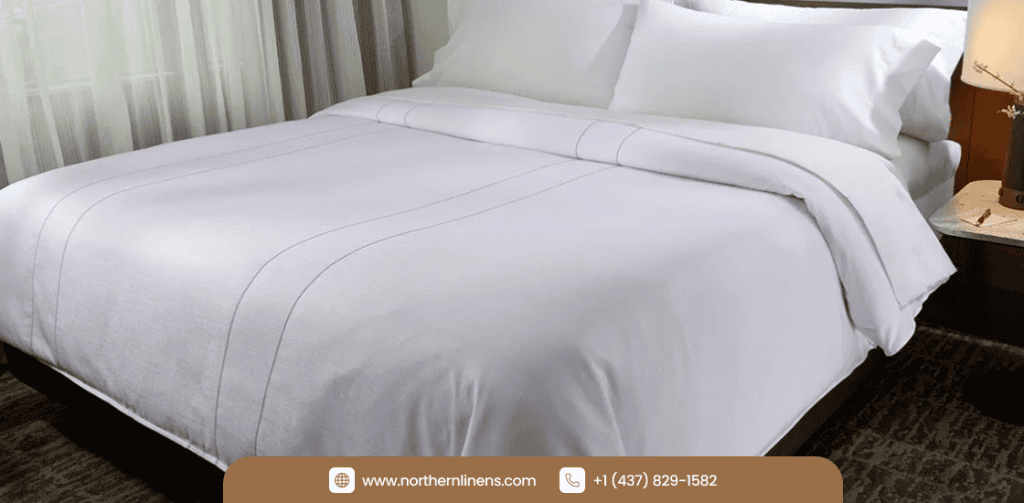
If you manage a hotel or resort in Toronto, the duvet cover is the linen item your guests see most and your laundry handles hardest. A cover that shrinks after ten washes no longer fits the insert. A closure that fails in the dryer stalls a housekeeper on every bed, and a fabric that greys makes a clean room look used.
Wholesale duvet covers are bought on how they behave after fifty washes rather than how they feel on the first. The procurement decisions that decide that are fabric, closure, sizing and par level.
The guide below covers the specification that survives a commercial laundry, what each property type needs from it, and how a property samples, prices and orders in bulk.
Specifying Wholesale Duvet Covers: Fabric, Closure and Cut Size
Three decisions decide whether a duvet cover stays in rotation for two years or goes to rags in six months. Each is made against your laundry, not your showroom.
Fabric Selection and Commercial Wash Life
Hotel duvet covers are cotton percale, cotton sateen, a cotton-polyester blend or bamboo viscose, and the choice is between guest feel and wash life. Long-staple cotton percale at 200 to 300 threads is the hotel standard, crisp and cool. Percale holds up to hot washing and ironing on the same rules as the hotel percale sheets used across Canadian properties. A 50/50 cotton-polyester blend shrinks less, dries faster and costs less per turn, at the price of a slightly warmer hand. Bamboo viscose suits boutique rooms where the feel is the point and the laundry is gentler.
| Fabric | Feel | Wash life at commercial temperatures | Shrinkage | Cost per turn |
|---|---|---|---|---|
| Cotton percale, 200 to 300 TC | Crisp, cool, matte | High at 60 to 70 degrees with ironing | Pre-shrunk fabric holds within 3 percent | Middle |
| Cotton sateen, 300 to 400 TC | Smooth, warmer, sheen | Moderate, sheen dulls with hot washing | Higher without pre-shrinking | Higher |
| 50/50 cotton-polyester | Slightly warmer, smooth | Highest, fastest drying | Lowest | Lowest |
| Bamboo viscose | Soft, cool, drapes | Moderate, warm wash and low heat | Moderate | Higher |
Whiteness is a fabric decision as well. A percale or blend that is optically brightened holds white through repeated hot washing. An unbrightened cotton yellows within a season under the same processing, which is the greying your guests notice before your housekeeper does.
Closure Design for Housekeeping Speed and Durability
The closure is where duvet covers fail. A hidden zipper is the fastest to change and the most likely to jam or catch in the dryer. A button placket is slower and outlasts the fabric. An envelope or tuck closure has nothing to break and can let the insert slip. Corner ties or loops inside the cover hold the insert in place whatever the closure. The closure design rules that apply to percale duvet covers in spas apply to every property, because changing time is a housekeeping cost paid on every room every day.
- Hidden zipper: fastest change, specify a heavy-gauge coil zipper with a covered pull
- Button placket: most durable, specify shell or resin buttons that survive hot drying
- Envelope or tuck: nothing to fail, specify a deep flap of at least 12 inches
- Corner ties: on every cover, whatever the closure, to hold the insert square
Cut Size to the Duvet Insert
A duvet cover is sized to the insert it will hold, and hotel inserts are oversized. A queen insert of 90 by 90 inches needs a cover cut to that insert with an allowance for shrinkage. A retail queen cover of 88 by 88 fits until the first hot wash. Measure the insert, add the fabric’s shrinkage allowance, and specify the cut size on the order. A cover that is too small bunches the insert and a cover that is too large lets it slide, and both show on a made bed. Northern Linens cuts to the insert dimension you supply, and the custom bedding programme holds that dimension on file for every reorder.
Specification by Property Type
A hotel, a boutique property, a rental portfolio and a student residence launder differently and are judged by different guests. The fabric, closure and par level shift with each.
| Property | Fabric | Closure | Par level | Colour |
|---|---|---|---|---|
| Full-service hotel or resort | Cotton percale or 50/50 blend | Hidden zipper or button | Three per bed | White |
| Boutique and luxury hotel | Long-staple percale, sateen or bamboo | Button placket | Three per bed | White or a signature tone |
| Vacation rental or Airbnb | 50/50 blend or percale | Hidden zipper | Two per bed | White, or a colour that hides wear |
| Student housing and residences | 50/50 blend | Hidden zipper or envelope | Two per bed, or one where students launder | Colour |
Full-Service Hotels and Resorts
A hotel runs a par of three covers per bed, one on the bed, one in the laundry and one on the shelf. The hotel buys white because white is bleachable and interchangeable across every room. The cover is changed between guests and on a stay-over schedule, and the laundry, on premise or contracted, processes it at 60 to 70 degrees with ironing. A property in Toronto, Mississauga or Montreal with 150 rooms and a mix of king and queen beds buys covers cut to each insert size at three par. The property chooses percale or a blend depending on whether the laundry is its own or a contractor’s. The processing arithmetic behind that choice is set out for commercial duvet covers in a laundry and rental operation.
Boutique and Luxury Hotels
A boutique property buys the cover for the guest, and the laundry follows. That means long-staple percale at 300 threads, a sateen for a warmer room or bamboo viscose for a cool one. The button placket reads as a finished detail rather than a fastening, and a signature colour is used where the brand calls for it. The par stays at three, because a boutique guest notices a cover that has been on the bed a day too long. The fabric decision runs on the same reasoning as the bamboo sheet sets bought for boutique and luxury hospitality, because the cover and the sheets are seen together.
Vacation Rentals and Student Residences
A rental portfolio and a student residence share a problem. The cover is laundered by a cleaner or a contractor with no hotel laundry behind it, or by the guest or the student in a shared machine. A 50/50 blend survives that, dries in a domestic dryer and shows less wear, and a hidden zipper lets a cleaner change it in a minute. A rental in Vancouver or Montreal runs two par per bed, one on and one in the wash. A student residence runs two par where it launders centrally and one where students wash their own. The same reasoning applies to the premium linen sheets bought for student housing. Colour hides wear in both, and a mid-tone cover stays presentable a season longer than white in a shared machine.
Cost Per Turn, Sampling and Bulk Ordering
A duvet cover is costed on its turns. A cover at a higher unit price that lasts 150 washes costs less per turn than one at half the price that lasts 60. The turns are decided in your laundry.
Calculating Cost Per Turn
Cost per turn is the unit price divided by the number of washes the cover survives before it is retired, plus the processing cost of each wash. Percale and blends survive the most turns at commercial temperatures. Sateen and bamboo survive fewer at hot temperatures and more at warm ones. A cover retired for a failed closure rather than a worn fabric has cost you its fabric life. That is why the closure is specified to outlast the cloth.
- Unit price divided by expected washes gives the fabric cost per turn
- Processing cost per wash, including ironing, is added on top
- A failed closure retires the cover early, so the closure is specified to the fabric’s life
- Shrinkage past the allowance retires the cover early, so the fabric is pre-shrunk or cut with allowance
Sample Testing in Your Own Laundry
Samples are sent so you can wash them, dry them and put them on a bed before you commit. Run the sample through your laundry’s actual cycle ten times, measure it against the insert, work the closure, and check the white against a new cover. Hand feel on day one tells you nothing about the cover on wash fifteen, and the sample that fails in your laundry saves you the carton.
Stocked, Custom and Private Label Orders
Stocked duvet covers ship by the carton from Northern Linens’ Canadian and US warehouses, usually within a few business days, to Toronto, Mississauga, Vancouver, Montreal and across Canada. A property that needs a cut size to its own inserts, a signature colour, a specific closure or a private label runs a custom order. The approved specification stays on file so every reorder matches the first.
| Order type | You choose | Minimum | Lead time |
|---|---|---|---|
| Stocked | Standard sizes, white, percale or blend, standard closure | By the carton | A few business days from stock |
| Custom | Cut size to your insert, fabric, closure, colour | Higher, quoted on the spec | Confirmed before the order is accepted |
| Private label | Everything in custom, plus your label and packaging | Quoted on the run | Confirmed before the order is accepted |
Send your room count, bed and insert sizes, and the laundry you use through Request a Quote, and bulk pricing, lead times and product samples come back from us. The duvet cover range sits in the Duvet Covers and Duvets category and on the duvet cover product page [INTERNAL LINK: duvet cover product page].
Procurement Requirements: RFQ, Compliance, Packaging and Terms
The specification decides the cover. The procurement decides whether three suppliers quote the same thing, whether the cartons arrive usable, and what happens when a cover fails.
RFQ Contents
A request for quotation that leaves out the laundry or the insert size produces three quotes for three different products. Send the items below with every RFQ, and ask each supplier to price against them line by line.
- Room count by bed size, with the insert dimensions measured flat
- Laundry type, on premise or contracted, with its wash temperature and whether it irons
- Fabric, thread count or blend ratio, and whether it is pre-shrunk and optically brightened
- Closure type, corner ties, and the colour or white
- Par level, so the quantity is three times the beds and not the beds
- Delivery address, receiving hours and the date the rooms open or turn over
- Certifications required by your compliance team
A quote that comes back with fabric, closure, cut size, quantity, freight and lead time itemised is the one you can compare. One that comes back as a price per cover is not.
Certification, Labelling and Carton Packaging
Hospitality buyers specify OEKO-TEX on the fabric so the compliance file shows the cloth was tested for harmful substances, and the certificate is supplied with the order. Each cover carries a sewn label with the size, the fibre content and the care instructions your laundry needs. A colour-coded hem tag by size cuts the sorting time at the folding table. Cartons are packed by size and colour, labelled on the outside, and counted against the packing list on the dock before they go to the linen room.
- OEKO-TEX certificate for the fabric, in the compliance file
- Sewn label with size, fibre content and care code on every cover
- Colour-coded hem tag by size, so king and queen never mix in the laundry
- Cartons packed and labelled by size and colour, with a packing list per carton
- Sample retained from each delivery as the reference for the next
Replacement Rate, Warranty and Payment Terms
A hotel replaces a share of its duvet covers every year through wear, staining and loss, and the replacement is budgeted rather than discovered. Plan the reorder on the retirement count from the laundry, the way the pillow protectors that extend linen life are budgeted against the pillows they save. Ask the supplier what happens to a cover that fails a seam or a closure inside its expected life, and what the replacement process is. Ask what the payment terms are for a stocked order and a custom run, and whether a first order is sampled before the balance is invoiced. Northern Linens supplies the specification record with every order so the replacement is the same cover, and the terms are set out on the quote rather than after it.
| Procurement item | What to ask | Why it matters |
|---|---|---|
| Replacement rate | The retirement count from your laundry per quarter | Sets the reorder quantity and cadence |
| Warranty | What is covered on seam, closure and fabric failure, and for how long | Decides who pays for an early retirement |
| Payment terms | Terms on stocked and custom orders, and on the first order | Sets the cash flow of a full linen refit |
| Consistency | Whether the spec is held on file and matched on reorder | Keeps the second delivery the same as the first |
| Delivery | Freight to your address, receiving hours, split deliveries | Decides the landed cost and the opening date |
Procurement Summary
The cover that stays in rotation is the one cut to your insert, closed to outlast its fabric, and chosen for your laundry’s temperature.
- Choose percale or a 50/50 blend for hot commercial laundering, sateen or bamboo where the feel matters and the wash is gentler
- Specify the closure to outlast the fabric, with corner ties on every cover
- Measure the insert and specify the cut size with the shrinkage allowance
- Run three par per bed in a hotel, two in a rental, and one or two in a residence depending on who launders
- Wash a sample ten times in your own laundry before the bulk order
- Send the insert size, the laundry and the par level with every RFQ, and compare quotes on the landed price
Tell us what your rooms need, and the samples, the bulk pricing and the lead time come back from Northern Linens.
Frequently Asked Questions
Should a hotel in Toronto buy percale or a cotton-polyester blend?
Percale if the laundry is your own and irons, because the guest feel is better and the fabric holds up. A 50/50 blend if the laundry is contracted or the property competes on rate, because it costs less per turn, dries faster and shrinks less. Many properties run percale in suites and a blend in standard rooms on the same closure and cut size.
How do I find the right cut size for my duvet inserts?
Measure the insert flat, width and length, and send the dimensions with the fabric you want. The cover is cut to the insert plus the fabric’s shrinkage allowance, so the fit holds after the first hot wash. A retail size label on the insert is not a cut size, because hotel inserts are oversized and retail covers are not.
What par level does a vacation rental need?
Two per bed, one on and one in the wash, plus a small spare stock for damage. A rental has no shelf stock in a laundry, so the second cover sits in the unit for the cleaner. A portfolio manager who standardises the cover across units carries one spare per five units.
Can Northern Linens match a duvet cover we already use?
In most cases, yes. Send the cover or its specification, and the fabric weight, thread count, cut size, closure and colour are matched as closely as the material allows. The record is kept on file for reorders, so the second delivery matches the first.
Do coloured duvet covers cost more to run than white?
No on the wash, and sometimes less on the replacement. Colour is not bleached, so it is processed at the same temperature as white without the bleach step. A mid-tone hides the wear that retires a white cover early. What colour costs is interchangeability, because a coloured cover serves only the rooms that use that colour.