Every wholesale bedding buyer eventually hits the same fork in the road: microfibre or cotton? Both materials have loyal advocates, and both deliver real value in the right setting. The wrong choice for your buying context, though, can cost you money, drive up returns, and create operational headaches that compound with every order.
Northern Linens is a wholesale bedding supplier and manufacturer serving retailers, hotels, Airbnb hosts, and commercial buyers across Canada and the United States. We stock both microfibre and cotton at wholesale depth, and we’re not here to push one over the other — we’re here to help you make the right call for your business, your guests or customers, and your margins.
Microfibre vs. Cotton at a Glance
There’s no single “better” material — the right one depends on your buyer type, climate, laundry cycle, and price point. Here’s how the two compare across the factors that matter most to bulk buyers:
| Factor | Microfibre | Cotton |
|---|---|---|
| Wholesale cost | Lower, more price-stable | Higher, varies with cotton market |
| Retail margin potential | Moderate | Higher, especially premium grades |
| Commercial wash durability | Strong across many cycles | Varies by grade and thread count |
| Breathability | Lower, traps more heat | Higher, natural moisture management |
| Best climate fit | Cooler or all-season | Warmer climates, hot sleepers |
| Best buyer fit | Mid-scale hotels, Airbnb, high-turnover rentals | Luxury hotels, premium retail |
What Is Microfibre? What Is Cotton?
Microfibre and cotton solve different problems, and understanding what each material actually is makes the rest of the buying decision much easier.
Microfibre
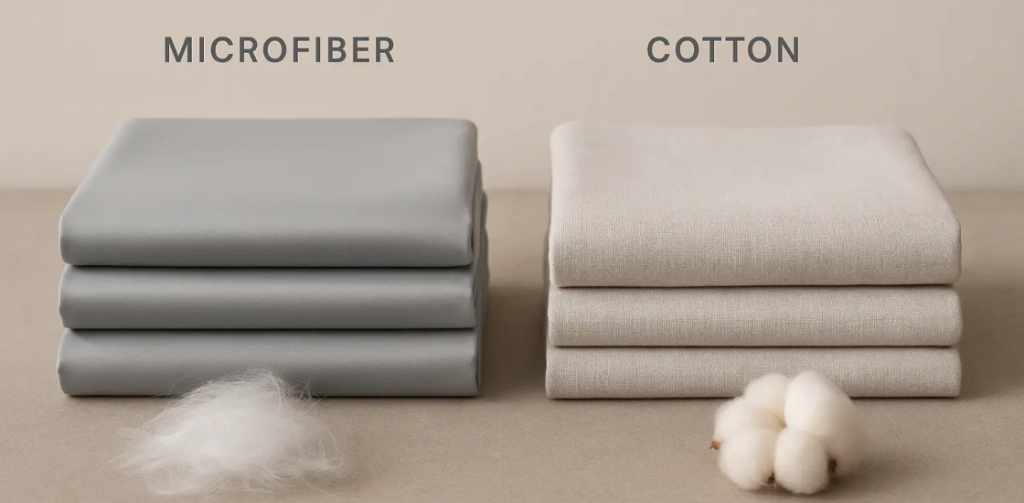
Microfibre is a synthetic fabric made from ultra-fine polyester, or polyester-nylon blend, fibres — each one under one denier in diameter. Woven densely, these fine fibres create a fabric that feels smooth, stays lightweight, and dries quickly. Modern microfibre has moved well past the stiff, “plasticky” synthetic feel older buyers may remember; brushed microfibre in particular can feel genuinely soft. For buyers exploring options at scale, our wholesale microfibre sheets range covers the current grades available for 2026 programs.
Cotton
Cotton is a natural fibre that’s been used in bedding for centuries, and it’s still the material most end users mentally compare everything else against. It breathes, absorbs moisture, and feels familiar. But “cotton” isn’t one product — grade, staple length, weave, and thread count all affect how a cotton sheet performs and what it costs. Buyers weighing cotton grades against price point may find our luxury bed sheets guide useful for comparing options.
The real question for a bulk buyer isn’t which material is objectively better. It’s which one performs best, at the best cost per use, for your specific buyer profile.
Cost Per Unit vs. Cost Per Use
The wholesale price tag only tells part of the story — cost per use, calculated across the sheet’s full wash-cycle lifespan, is what actually determines value for a commercial buyer.
Microfibre typically costs less per unit than comparable-grade cotton at wholesale. Synthetic fibre production is more price-stable than cotton, which is exposed to weather, harvests, and commodity market swings. That makes microfibre attractive if you’re managing a tight procurement budget or scaling fast and need predictable supply.
Premium cotton, on the other hand, commands a higher retail price and can deliver stronger retail margin in the right market. A well-positioned cotton percale or sateen line can retail for several times the price of a comparable microfibre product — the margin per unit is often higher even though the wholesale cost is too. Our premium sheet sets guide breaks down how these margins typically play out at different price tiers.
Northern Linens structures wholesale pricing for both materials to protect buyer margin at every volume tier, whether your model runs on velocity or premium positioning.
Not sure which fits your buying model? Contact Northern Linens for a free consultation and samples of both ranges.
Durability Under Commercial Laundry Conditions
Durability is where this comparison gets serious for hospitality and rental buyers, because hotel and Airbnb bedding goes through dozens of commercial wash cycles a year — and the fabric that survives that cycle intact is the one with the lowest real cost per use.
High-quality microfibre holds up well under repeated commercial laundering: it resists pilling, keeps its shape, and holds colour consistently over time when laundered correctly.
Cotton durability depends heavily on grade and thread count. Long-staple cotton — Egyptian or Pima grades — holds up across extended commercial use. Shorter-staple, lower-thread-count cotton wears faster and can start showing pilling or distortion much sooner under heavy commercial laundry conditions. If you’re comparing specs on paper, our thread count vs. GSM guide explains which numbers actually predict durability.
Northern Linens selects microfibre specifically for commercial laundry durability when supplying hotel and Airbnb clients, and sources our commercial cotton range to specifications built for extended use cycles.
Softness and the Sleep Experience
What a sheet feels like against the skin is the first thing an end user notices — and it’s what shapes hotel reviews, retail return rates, and Airbnb guest ratings.
Brushed microfibre delivers a softness that genuinely surprises a lot of first-time buyers who expect a synthetic feel.
Premium cotton still has a quality synthetic materials haven’t fully matched: it breathes, wicks moisture, and helps regulate sleep temperature — something warmer-climate buyers in particular tend to value.
Northern Linens stocks brushed microfibre for mid-range programs and premium cotton for buyers whose audience specifically expects natural fibre. For a deeper look at how fabric choice affects guest experience, see our commercial hotel sheet fabric guide. Getting this match right protects your brand positioning as much as your margin.
Temperature Regulation and Breathability
Temperature regulation is one of the clearest practical differences between the two materials in everyday use.
Cotton’s open fibre structure allows air to circulate and manages moisture naturally, which makes it a strong fit for warmer climates, care facilities, and luxury hospitality settings.
Microfibre’s tighter weave makes it less breathable, but that’s an advantage in cooler climates, all-season use, or mid-range hospitality where guests aren’t typically running hot.
Sustainability Considerations for Bulk Buyers
Sustainability has become a real line item in wholesale bedding decisions, and both materials carry different trade-offs worth understanding before you commit to a program.
Cotton: Conventional cotton farming uses significant water and pesticide inputs. Organic or sustainably certified cotton addresses this but typically carries a price premium.
Microfibre: Synthetic fibres shed microplastics during washing. Recycled polyester microfibre reduces reliance on virgin resources and is increasingly available at wholesale volume.
Northern Linens tracks supplier sustainability certifications for both materials and can advise on responsible options that fit your procurement policy.
Which Material Fits Your Buyer Type?
- Mid-scale hotels and commercial hospitality: Microfibre — durability, cost stability, consistent quality across high wash volumes.
- Luxury hotels and premium retail: Long-staple cotton — breathability, natural feel, and brand positioning that matches a premium price point.
- Airbnb and short-term rentals: Microfibre — appearance retention, fast turnaround laundering, and guest satisfaction at a manageable cost.
- Retail buyers: Stocking both materials across price tiers usually gives the most balanced program performance.
- Healthcare and care facilities: The right material depends on clinical laundry protocols and resident comfort needs — this one is worth a direct conversation rather than a default choice.
Ready to build your bulk bedding program? Request your Northern Linens wholesale catalogue and bulk pricing today.
Northern Linens: Your Wholesale Bedding Partner
Northern Linens supplies wholesale bedding to retailers, hotels, Airbnb hosts, and commercial buyers across Canada and the United States, including:
- Microfibre sheets
- Cotton sheets
- Comforter sets
- Duvet covers
- Quilts
- Pillows
- Mattress protectors
- Bath towels
- Blankets
- Reusable underpads
- Hanger solutions
Both microfibre and cotton have a legitimate place in a well-built wholesale bedding program — the goal is matching the right material to the right buyer, not defaulting to one material across your whole catalogue.
Contact Northern Linens today to request a free sample pack of both microfibre and cotton ranges, get wholesale pricing, and talk through your program with a bedding specialist.
Frequently Asked Questions
Which bed sheet is better, microfibre or cotton?
Neither is universally “better” — they suit different priorities. Microfibre is synthetic, tightly woven, durable, wrinkle-resistant, and cost-effective, which makes it a strong fit for high-volume, budget-conscious operations like mid-scale hotels and Airbnb rentals. Cotton is natural and breathable, with a familiar feel that suits premium comfort positioning and luxury hospitality, though it needs more careful laundering to avoid shrinkage or wrinkling. Choose microfibre for high-turnover, cost-sensitive programs, and cotton for premium comfort and natural feel.
What are the disadvantages of microfibre sheets?
Microfibre can trap more heat than cotton, which makes it feel warmer for hot sleepers. Conventional microfibre also sheds microplastics during washing, though recycled polyester versions reduce this impact. And while modern brushed microfibre is genuinely soft, it still doesn’t fully replicate cotton’s natural breathability and moisture regulation. When buying, check the fabric’s GSM (grams per square metre) — a higher GSM within a reasonable range generally signals a denser, more durable weave.
What sheets do most luxury hotels use?
Luxury hotels typically favour premium long-staple cotton, such as Egyptian or Pima grades, for its breathability, natural softness, and alignment with a high-end guest experience. Mid-scale or high-turnover properties more often use microfibre, valuing its durability, cost-effectiveness, and low-maintenance laundry performance. In either case, the priority for hospitality buyers is a fabric that withstands frequent commercial laundering without pilling, shrinking, or fading.
How does microfibre compare to cotton for comfort and durability?
For comfort, cotton generally regulates temperature better, absorbs moisture naturally, and sleeps cooler, while microfibre feels smooth and soft and suits mid-range markets well. For durability, microfibre tends to resist tearing and holds colour across many wash cycles, while cotton’s durability depends heavily on thread count and staple length — long-staple cotton holds up better than standard cotton. Microfibre also dries faster and generally needs less careful maintenance, which matters for high-volume hospitality laundry operations.
What should bulk buyers in Canada and the US consider before ordering?
Climate matters: microfibre tends to suit cooler regions, while cotton is often preferred in warmer regions or by hot sleepers. Maintenance load matters too, since microfibre generally reduces laundry time and staff workload in high-turnover operations. Buyers should also weigh their specific audience — hotel, Airbnb, or retail — since that shapes the right balance of durability, comfort, and margin for the program.
Can a wholesale program mix both microfibre and cotton?
Yes, and for many retail and hospitality buyers, mixing both materials across price tiers is the most effective strategy. Microfibre can cover cost-sensitive, high-turnover lines, while cotton covers premium positioning within the same catalogue. Northern Linens structures wholesale pricing for both materials so buyers can build a blended program without sacrificing margin at either tier.
How often should commercial bedding be replaced?
Replacement timing depends on fabric quality, wash frequency, and laundering conditions rather than a fixed calendar. Higher-quality microfibre and long-staple cotton both hold up over a longer number of commercial wash cycles than lower-grade versions of either material, which is why grade and construction — not just material type — should drive a replacement schedule. If you’re seeing pilling, thinning, or colour loss earlier than expected, it’s usually a sign the fabric grade doesn’t match your laundry volume.
Does thread count actually matter when buying cotton in bulk?
Thread count matters, but only within a reasonable range and alongside staple length and weave quality — an inflated thread count on short-staple cotton won’t outperform a moderate thread count on long-staple cotton. For bulk buyers, it’s more useful to ask about fibre grade and weave construction directly with your supplier than to buy on thread count alone.