A room where bedding and curtains work together as one visual story books faster, photographs better, and holds a higher nightly rate than one where they don’t. Procurement teams, interior designers, serviced apartment operators, and retail buyers increasingly treat this as a sourcing problem, not just a styling one: the challenge isn’t picking a look, it’s finding a supplier who can deliver that look consistently across dozens or hundreds of units.
This guide is written for buyers working at volume. It covers the colour and fabric logic behind coordinated bedroom textiles, how to layer pieces so rooms feel designed rather than matched, and what to look for in a wholesale bedding supplier who can support the program long-term.
Why Do Coordinated Bedding and Curtains Matter for Commercial Buyers?
Coordinated textiles matter commercially because room aesthetics directly influence guest reviews, and reviews directly influence bookings and rate. Roughly nine in ten travelers read reviews before booking, and industry research from Harvard Business School has linked a one-star rating improvement to a 5–9% revenue increase for a property. Buyers weighing the ROI of a full textile refresh can review this hotel bedding buying guide for a deeper look at how furnishings factor into guest satisfaction scores.
For retail buyers, the logic runs the other way but lands in the same place: shoppers increasingly want a finished look rather than separate pieces.
- Hospitality: coordinated rooms photograph more consistently across listing platforms, which supports review quality and repeat bookings
- Serviced apartments: a cohesive, residential-feeling room reduces the “hotel-like” perception guests often flag in reviews
- Retail: pre-matched bedding and curtain sets shorten the buying decision and tend to raise average order value
- Property management: consolidating bedding and curtains under one supplier cuts the procurement hours spent reconciling colourways across vendors
What Colour Strategy Works Best for Coordinating Bedding and Curtains at Scale?
The most scalable colour strategy for multi-property buyers is a neutral anchor: a fixed neutral bedding base paired with a curtain accent that can be refreshed independently. This structure lets a hotel group update the “feel” of a property or room tier without replacing the entire textile program.
| Strategy | Bedding | Curtains | Best For |
|---|---|---|---|
| Neutral anchor | White, ivory, stone, warm grey | Sage, dusty blue, charcoal, terracotta (accent) | Hospitality groups refreshing seasonally or by room tier |
| Tonal matching | Pale linen, oatmeal, soft white | Same colour family, deeper depth (e.g., medium taupe) | Boutique properties wanting a designed look without pattern-matching risk |
| High-contrast | White or ivory | Deep jewel tones (navy, emerald, burgundy) | Premium tiers only — avoid in standard guest rooms, where it can read as clinical |
A few practical rules that hold up across room sizes and light conditions:
- Keep high-contrast palettes out of standard guest rooms; they photograph sharply but can feel cold in person
- Pair deep jewel-tone curtains with solid neutral bedding, not patterned duvet covers, to avoid visual competition
- Tonal matching is more forgiving across varied natural light than exact colour-matching
How Should Fabric Be Selected for Coordinated Commercial Textile Programs?
Fabric choice should be based on how often each item is laundered, not just how it looks on day one. Bedding is washed far more frequently than curtains, so the two need different fibre priorities even within the same coordinated collection. For a full breakdown of fibre performance under commercial laundering, this commercial hotel sheet fabric guide covers the tradeoffs in more depth.
For bedding: percale weave cotton and high-quality cotton-polyester blends hold up best under repeated high-temperature commercial laundering. Weave structure and fibre quality matter more here than thread count — a lower thread count in a tight percale weave will outlast a higher thread count in a looser weave, a point covered further in this thread count vs GSM guide and this percale sheets buying guide.
For curtains: since they aren’t laundered as often, the fabric range can be wider. Linen-look polyester is a practical volume choice — it holds its drape, resists UV fading, and cleans easily. Velvet or blackout-lined curtains suit premium room tiers where light control or acoustic softening is a functional requirement, not just an aesthetic one.
| Fabric | Best Use | Key Advantage |
|---|---|---|
| Percale weave cotton | Bedding | Crisp feel, launders well at high heat |
| Cotton-polyester blend | Bedding | Durability with softer maintenance needs |
| Linen-look polyester | Curtains (standard rooms) | UV-resistant, holds drape, easy care |
| Velvet / blackout-lined | Curtains (premium tiers) | Light control, acoustic softening |
How Do You Layer Bedding and Curtains So a Room Feels Designed, Not Matched?
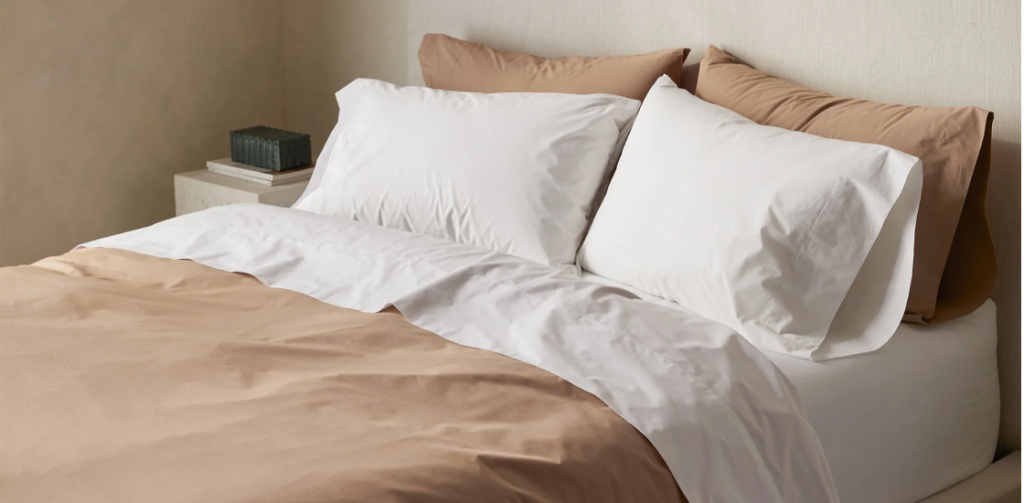
A coordinated room reads as designed when it’s built in three layers — a crisp base, a textural mid-layer, and curtains that support the palette without competing with the bed for attention. Over-matching every element is what makes a room feel generic rather than styled.
Practical layering guidance:
- Base layer: the sheet set and duvet cover carry the room’s primary colour statement
- Mid-layer: a throw or coverlet in a curtain-adjacent (not identical) tone bridges the bed to the window visually, and buyers sourcing at volume can compare options in this wholesale throws guide
- Accent layer: Euro shams in a neutral tone add a styled, layered look at low incremental cost
One rule worth flagging for procurement teams: avoid matching pillowcase borders exactly to curtain fabric. It’s a small detail, but it’s the difference between “coordinated” and “overdone” in guest photos.
How Do Bulk Buyers Source Coordinated Collections Without Colour Variance Across Units?
The reliable way to avoid colour and quality variance across a property or product line is single-source procurement: sourcing bedding, curtains, and accent pieces from one supplier working from unified collection families and controlled dye lots. Multi-vendor sourcing is where most large coordination programs break down. This wholesale bedding sourcing guide walks through what to look for when consolidating vendors.
A hotel group refreshing 80 rooms needs the same curtain fabric and matching bedding SKUs available on a repeatable schedule — not a one-time match that can’t be reordered identically eighteen months later. This is a supply chain question as much as a design one, and it’s worth reviewing alongside a premium sheet sets wholesale guide before committing to a single supplier.
What to check before consolidating suppliers:
- Does the supplier manage dye lots so reorders match the original shipment?
- Can bedding, curtains, and throws be ordered under one account with one lead time?
- Are tiered pricing and replenishment programs available for ongoing turnover, not just initial fit-out?
- What’s the standard lead time for stock items versus custom colourways?
Frequently Asked Questions
Do wholesale suppliers offer bedding and curtains under the same order structure?
Suppliers built for coordinated programs typically allow bedding and curtains to be ordered under one wholesale account, with minimum quantities discussed per SKU and mixed orders accommodated within a single collection family.
Can colourways or fabrics be customised for large orders?
Custom production is generally available once an order meets the supplier’s minimum production run, and it’s most common for hospitality groups or retailers building house-brand or private-label collections. Custom runs typically carry longer lead times than stock orders.
How is colour consistency maintained across production batches?
Reliable suppliers apply dye lot management and can reserve production from a single dye lot for large orders shipped in multiple batches — an important ask for any buyer needing identical colour across many rooms.
Are commercial curtain fabrics treated for UV resistance or fire safety?
Many commercial curtain ranges include UV-inhibiting treatments or flame-retardant finishes, though compliance requirements vary by region and occupancy type, so buyers should confirm jurisdiction-specific requirements at the enquiry stage.
What’s a realistic lead time for a first wholesale order of coordinated bedding and curtains?
Stock items commonly ship within one to two weeks of order confirmation, while custom or large-volume orders need a separate timeline confirmed during quoting.
Does room aesthetic actually affect hotel revenue, or is it just a style preference?
It has a measurable link to revenue: most travelers read reviews before booking, and a one-star rating improvement has been associated with a 5–9% revenue increase in hospitality research, with room condition and furnishings cited as a consistent driver of guest satisfaction.
Is thread count the most important factor in commercial bedding quality?
No — weave structure and fibre quality matter more than thread count for how bedding performs under repeated commercial laundering; a tightly woven percale at a moderate thread count typically outlasts a loosely woven higher-thread-count fabric.