A commercial mattress protector is washed at 60 to 71 degrees on every change, and under a monthly laundering schedule it is replaced every 12 to 18 months. In a Toronto hospital it is also the barrier between a patient and a mattress that will carry the next one. Staff inspect it for intact seams and an unbroken membrane at every strip. A protector bought on price alone fails one of those tests within the year, and the mattress it was meant to protect is the thing that pays for it.
In this guide, we set out the five points a wholesale mattress protector is specified on and what changes between healthcare, hotels, senior living and student housing.
The Five Points a Commercial Mattress Protector Is Specified On
A protector is a barrier and a surface at once. Your specification has to cover both, and the five points below are what your tender or quote request lists.
Barrier: Waterproof Membrane and Breathability
The barrier is a polyurethane or thermoplastic membrane laminated to the fabric. A fully waterproof membrane stops liquid reaching your mattress, and a breathable one lets vapour through so the surface does not sweat. Both are measured, and your specification states them.
- Waterproof to a stated hydrostatic head, so a spill or incontinence does not pass
- Breathable to a stated vapour transmission rate, so the bed does not feel clammy
- Membrane bonded to the fabric, not a separate sheet, so it survives laundering
- Quiet in use, which rules out the crinkling film a domestic product uses
Surface: Terry, Jersey or Smooth
The face fabric is what your sheet lies on and what your guest or resident feels through it. Cotton terry absorbs and feels soft, and it is the hospitality standard. Polyester jersey is lighter, dries faster and suits healthcare laundering. A smooth, wipeable polyurethane surface is the long-term care and acute-care choice, because it is cleaned in place between patients without being removed.
Fit: Fitted Skirt or Full Encasement
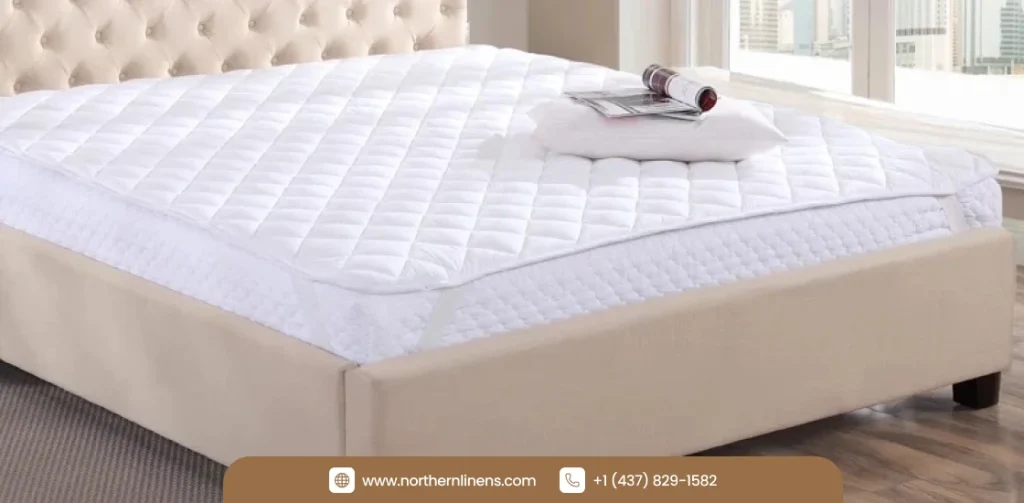
A fitted protector covers the top and sides with an elastic skirt and comes off for laundering on every change. A full encasement zips around the whole mattress and stays on, which is the bed bug and infection-control standard. Healthcare and senior living usually run both, an encasement on the mattress and a fitted protector over it that is changed with the linen.
| Fit | Changed | Best for |
|---|---|---|
| Fitted, elastic skirt | With the linen | Hotels, short-term rentals, student housing |
| Full zippered encasement | Rarely, on inspection | Healthcare, senior living, bed bug control |
| Encasement plus fitted protector | Protector with the linen, encasement on inspection | Hospitals and care homes |
Laundering: Temperature, Cycles and Drying
A commercial protector is specified for the laundry it will go through, not the one a domestic label assumes. Ask for the maximum wash temperature, the number of wash cycles the membrane is rated for, and the drying instruction. High heat in the dryer is what delaminates a membrane before its time.
- Wash at 60 to 71 degrees, which is the range healthcare and hospitality laundries run
- Rated for a stated number of commercial cycles, with the membrane intact at the end
- Tumble dry on medium, because high heat shortens the membrane’s life
- No chlorine bleach where the membrane does not tolerate it, stated on the care label
Compliance: Certification and Documentation
A protector is a textile, and it sits on a mattress that is a regulated product. Health Canada’s Mattresses Regulations require every mattress sold in Canada to pass a cigarette ignition test, and a healthcare buyer’s compliance team asks what sits on top of it. Specify OEKO-TEX certification for the fabric, the flammability documentation the supplier holds, and the laundering data sheet, and have all three in the file before the order.
What Changes Between Healthcare, Hotels, Senior Living and Student Housing
The five points are the same everywhere. The weight each carries changes with the setting, and a procurement team buying for several settings runs more than one specification.
Healthcare and Hospitals
Infection prevention sets the specification. The protector or encasement has to be fully waterproof, wipeable with the disinfectant your facility uses, and intact. A cut or a worn seam lets fluid reach the mattress core, and the mattress is then condemned. Encasements are inspected at every bed strip and replaced on any damage regardless of age. Laundering runs at the top of the temperature range, and the membrane is rated for it.
- Full encasement with a smooth, wipeable surface
- Fitted protector over it, changed with the linen
- Membrane rated for 71 degree laundering and the facility’s disinfectant
- Inspection at every strip, replacement on any damage
Hotels and Inns
Guest feel sets the specification. The protector is fitted and changed with the linen, the surface is terry or a soft jersey the guest does not notice, and the membrane is quiet. Waterproofing matters for the mattress and the housekeeping budget, because a spill that reaches a hospitality mattress is a mattress replaced early. The cycle is 12 to 18 months under monthly laundering, shorter on a high-occupancy floor.
Retirement and Senior Living
Incontinence and skin integrity set the specification. The protector is fully waterproof and breathable, because a non-breathable surface holds heat and moisture against the skin. A long-term care home runs an encasement on every mattress and a fitted protector changed as often as the resident needs, and the laundry is a healthcare laundry. Replacement is on soiling and inspection rather than on a date.
Student Housing and Residences
Turnover sets the specification. A fitted waterproof protector goes on every bed, is laundered on the residence cycle, and is replaced annually or between tenants. If your residence beds run twin XL, as most do, a standard twin protector does not stay on.
| Setting | Fit | Surface | Replace |
|---|---|---|---|
| Healthcare and hospitals | Encasement plus fitted protector | Smooth wipeable, jersey over it | On damage, inspected every strip |
| Hotels and inns | Fitted | Terry or jersey | 12 to 18 months |
| Senior living | Encasement plus fitted protector | Breathable waterproof | On soiling and inspection |
| Student housing | Fitted, twin XL | Jersey | Annually or between tenants |
How to Run the Bulk Purchase from Sample to Standing Order
A wholesale purchase is specified, sampled, ordered and then reordered, and the money is saved or lost at the first two stages.
Write the Specification Before You Ask for a Price
List the five points for each setting, with the sizes and quantities by bed. State the laundering your protectors will go through and the number of cycles you expect from them. A supplier quoting against a stated cycle count is quoting a product built for it. Ask for the certification and the laundering data sheet with the quote, not after it.
Sample, Launder, Inspect, Then Order
We send samples so your laundry can wash them at your temperatures and dry them on your cycle. Your infection-control or housekeeping lead then inspects the membrane and seams. The protector that passes your laundry is the one the order is cut to. The specification goes on file so your reorder in 12 or 18 months matches it. Our mattress protectors and pads are supplied that way, with OEKO-TEX certified fabrics and the documentation your compliance team needs on file.
| Stage | What you do | What we do |
|---|---|---|
| Specification | List the five points, sizes and quantities by setting | Confirm the product that meets each, or propose one |
| Samples | Wash, dry and inspect on your own cycle | Supply samples and the laundering data sheet |
| Order | Approve the specification that passed | Cut the order to it and phase delivery to your schedule |
| Reorder | Call off on the cycle | Supply from the held specification, from stock in Canada |
Set the Replacement Cycle and the Reorder
Decide your cycle by setting, 12 to 18 months for hotels, annually or between tenants for residences, and on inspection for healthcare and senior living. Set the reorder before the cycle ends. Build the replacement into your annual linen budget rather than waiting for a failure, because a protector that fails is a mattress that follows. Request a quote or samples with your bed count, sizes and laundering temperatures, and pricing and samples come back from our Canadian stock.
Specify for Your Laundry and Your Setting, Then Buy on the Specification
A mattress protector bought wholesale is a barrier, a surface and a laundering specification, and the setting decides how much of each you need.
- Specify the membrane, the surface, the fit, the laundering and the certification, in writing, for each setting
- Run an encasement plus a fitted protector in healthcare and senior living, and a fitted protector in hotels and residences
- Sample on your own laundry cycle before you commit a bed count
- Budget the replacement cycle by setting and reorder before it ends
- Hold the specification on file so every reorder matches
Send us your bed count, sizes, settings and laundering temperatures. Northern Linens will return a specification for each setting, bulk pricing and samples your laundry can test.
Frequently Asked Questions
Do we need an encasement and a protector on every healthcare bed, or one or the other?
Both, in most facilities. The encasement stays on the mattress and is the infection-control and bed bug barrier, inspected at every strip. The fitted protector goes over it and is changed with the linen, so the encasement is laundered rarely and lasts. One without the other leaves either the mattress or the laundry exposed.
How do we know a protector will survive our laundry?
Ask for the rated cycle count and the maximum temperature, then test it. We send samples for your laundry to wash at your temperatures and dry on your cycle, and your team inspects the membrane afterwards. A protector that survives twenty of your cycles with the membrane intact is specified; one that delaminates is not.
Will a waterproof protector make the bed feel hot?
Not if the membrane is breathable. A non-breathable film holds heat and moisture, which is why domestic products crinkle and sweat. A breathable polyurethane membrane under a terry or jersey face passes vapour and stays quiet, and that is the specification for a hotel or a care home bed.
What sizes should we hold for a mixed estate?
The sizes of your mattresses, measured, including depth, and including twin XL for residences and the deeper hotel mattresses that run 12 to 20 inches. A protector sized to the catalogue rather than the bed does not stay on, and a fitted protector that migrates is one housekeeping resets every day.
Can we buy a small quantity to test before a full order?
Yes. Stocked lines are sold by the carton, which suits a single property or a single ward trying the product, and samples go out before that. The bulk price applies once the specification is agreed and the order is placed on it.