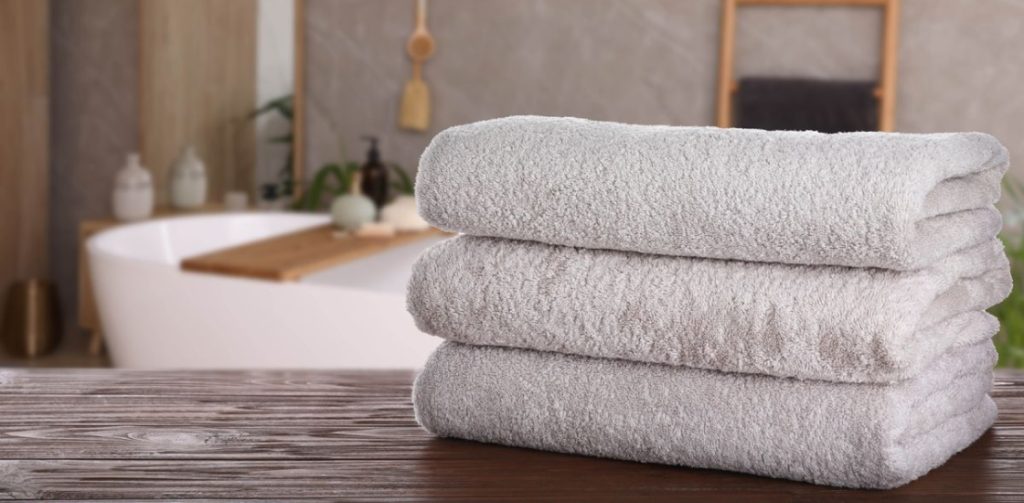
A premium bath set is worth the extra cost when its GSM weight, cotton staple length, and safety certification are backed by documentation — not just a soft feel in the store. This guide breaks down exactly what to check before buying, why some “luxury” towels thin out within a few months, and how to tell a genuinely well-made bath set from one that just looks the part on a shelf.
You touch a towel twice a day, every day, for years. That’s more physical contact than almost any other textile in your home gets — more than your sheets, more than your clothes. Yet most people choose a bath towel on colour and price alone, then wonder why it’s rough and thin within six months. The difference between that towel and one that gets softer with age comes down to three measurable things: fabric weight, fibre quality, and how the fabric was finished. If you want the full breakdown of how these two metrics relate, see this thread count vs GSM guide.
What Does “Premium” Actually Mean for a Bath Towel?
A bath towel earns the word “premium” when it’s heavier per square metre, made from longer cotton fibres, and certified free of harmful finishing chemicals — three facts you can ask any retailer to confirm. Everything else (thread count claims, packaging, brand name) is secondary to these three. For a broader look at what separates entry-level from top-tier ranges, this luxury bath sets guide covers the full spectrum.
Quick comparison — what separates the tiers:
| Quality tier | Typical GSM | Fibre | Feel after 6 months |
|---|---|---|---|
| Budget | 300–400 | Short-staple cotton blend | Thin, prone to pilling |
| Mid-range | 400–550 | Standard cotton | Holds up reasonably, some pilling |
| Premium | 600–900 | Long-staple (often Egyptian or Turkish) cotton | Softer than day one, minimal pilling |
GSM Explained: Why This Number Predicts How a Towel Will Feel and Perform
GSM stands for grams per square metre, and it’s the closest thing the towel industry has to a single reliable quality score. The higher the GSM, the denser the loop pile, and the more water the towel can absorb per square centimetre.
Here’s the practical range to know:
- Under 400 GSM: thin, quick-drying, but limited absorbency — common in budget hotel and economy retail towels
- 400–550 GSM: a reasonable everyday towel, adequate absorbency, moderate weight
- 600–900 GSM: dense, plush, and substantial — the range associated with luxury hotel bath linen and genuinely premium retail sets
A word of caution worth knowing before you shop: GSM figures printed on packaging are usually self-reported by the manufacturer and aren’t independently audited in most retail contexts. A high GSM number paired with poor fibre quality can still pill and thin — GSM tells you about density, not necessarily about how the yarn was spun or twisted. Treat it as one strong signal among several, not the only one. Buyers comparing hotel-grade specifications in depth may also find this hotel bedding buying guide useful.
Cotton Quality: Why Fibre Length Matters More Than the Word “Cotton” Alone
Long-staple cotton varieties — including Egyptian and Turkish cotton — produce noticeably more durable towels than short-staple cotton, because longer fibres leave fewer loose ends exposed in the loop pile. Fewer exposed ends means less pilling, less surface roughness, and a towel that tends to soften with washing rather than degrade.
This is the part most shoppers miss: “100% cotton” on a label tells you almost nothing about durability on its own. Two towels can both be 100% cotton and behave completely differently after a month of use, because the fibre length and the yarn twist are what actually determine how the loop pile holds up. The same fibre-length principle applies to bedding, as explained in this percale sheets buying guide.
What to look for on a label or product description:
- Fibre type named specifically (Egyptian cotton, Turkish cotton, Supima, or long-staple cotton) rather than just “cotton”
- GSM stated as a number, not just a vague word like “heavyweight”
- A finishing or certification claim you can independently verify (see below)
OEKO-TEX Certification: What It Covers and Why It’s Worth Checking for a Daily-Use Product
OEKO-TEX Standard 100 certification means every component of the textile — the raw fibre, the dyes, and the finishing chemicals — has been independently tested against a defined list of substances and found free of them. For a product that sits directly on skin twice a day, that’s a meaningfully different guarantee than a marketing claim of “eco-friendly” or “natural.”
Here’s why this matters in practice: many conventional towels are treated with synthetic softening agents and optical brighteners at the factory. These make the towel feel exceptionally soft on day one — often softer than a genuinely well-made towel — and then wash out within the first several launderings, leaving a rougher, thinner-feeling towel behind. A certified, uncoated fabric doesn’t have that artificial peak; instead, it tends to improve gradually with washing as the natural fibres relax.
How to verify a certification claim, rather than just trusting a logo on the box:
- Ask for the specific certificate number
- Check that number against the OEKO-TEX Standard 100 public database
- Confirm the certificate applies to the actual product line you’re buying, since certification is issued per product and per factory, not as a blanket brand claim
What a Complete Bath Set Should Include
A properly structured bath set covers every drying need in a bathroom with pieces sized for their specific function, not just matching colours bundled together. Shoppers comparing full range options across piece counts and coordinated colourways may find this luxury bath sets Canada guide a helpful companion.
| Piece | Typical size | Main use |
|---|---|---|
| Bath sheet | ~100 x 150 cm | Full-body wrap, highest weight in the set |
| Bath towel | ~70 x 140 cm | Everyday post-shower drying |
| Hand towel | ~50 x 90 cm | Bathroom hand-drying, vanity use |
| Face cloth | ~30 x 30 cm | Facial cleansing, skincare routines |
| Bath mat | Varies | Completes the coordinated set |
Buying a set rather than individual pieces from different sources is mostly about consistency — matching colour, matching weight, and matching how each piece ages, so your bathroom doesn’t end up with one towel that’s still plush next to another that’s already gone thin.
How to Wash a Premium Bath Set Without Undoing What You Paid For
The short version: skip the fabric softener, use a moderate wash temperature, and don’t overload the machine. Fabric softener is the single most common way people accidentally shorten the life of a good towel.
Step-by-step care that actually preserves GSM and absorbency:
- Wash new towels before first use — this removes manufacturing residue and lets the loop pile reach full absorbency
- Use warm water on a regular cycle with a standard detergent
- Skip fabric softener; it coats the cotton loops with a residue that reduces absorbency over time, which defeats the point of a high-GSM towel
- Don’t overload the washing machine — towels need room to agitate freely for the loop pile to clean and rinse properly
- Tumble dry on medium heat or line dry; either preserves the loop structure better than very high heat
A properly made, certified cotton towel is designed to soften with repeated washing rather than degrade — if your towels are getting rougher over time despite following these steps, the fibre quality or finishing chemistry is the likely culprit, not your laundry routine.
Buying for a Business: What Changes for Hospitality, Retail, or Private Label Orders
The specification standards described above don’t change when you’re buying for a hotel, a retail range, or a private label programme — but the verification burden goes up, because you’re accountable for consistency across hundreds or thousands of units. A hotel operator or retail buyer sourcing bath sets should ask for batch-level certification documentation (not just a one-time sample cert), confirmed GSM tolerances across production runs, and — for private label — clarity on minimum order quantities and colourway exclusivity before committing to a development brief. Buyers building out a full programme may also want to review this wholesale bath linen guide alongside this bulk bedding supplier guide before finalizing a sourcing decision.
Frequently Asked Questions
What GSM is considered luxury for a bath towel?
Luxury bath towels typically run between 600 and 900 GSM. Below 600, a towel can still be perfectly good for everyday use, but the plush, substantial feel associated with high-end hotel linen generally starts around this range.
Does higher GSM always mean a better towel?
Not necessarily. Past around 900 GSM, towels get heavier, take longer to dry, and cost more to launder without a proportional improvement in feel. Fibre quality and finishing matter as much as the raw GSM number, so a well-made 650 GSM towel can outperform a poorly made 800 GSM one over time.
Why do some towels feel rough after just a few washes even though they felt soft in the store?
This is almost always caused by synthetic softening agents applied at the factory to create an appealing first impression. These coatings wash out quickly, revealing the towel’s true, less refined texture underneath. A genuinely well-made towel with certified, uncoated fibres tends to do the opposite — it softens gradually with use.
Is Egyptian cotton actually better than regular cotton?
Egyptian cotton is a long-staple cotton variety grown mainly in Egypt’s Nile Delta, and its longer fibres do produce a stronger, less pilling-prone yarn than typical short-staple cotton. That said, “Egyptian cotton” claims aren’t independently regulated in most markets, so a fibre-length or staple-length spec from a reputable supplier is a more reliable check than the name alone.
Should I use fabric softener on premium towels?
No — fabric softener coats cotton loops with a residue that reduces absorbency over time, which works against the entire point of buying a high-GSM towel. Skipping it and washing regularly is enough to keep a well-made towel performing as intended.
What’s the difference between a bath towel and a bath sheet?
A bath sheet is larger, at roughly 100 by 150 centimetres versus a bath towel’s 70 by 140 centimetres, and is designed for a full-body wrap rather than just drying off. It typically carries the highest GSM in a coordinated set.
How do I check if a towel’s OEKO-TEX certification is real?
Ask for the specific certificate number and check it against the OEKO-TEX Standard 100 public database rather than trusting a printed logo. Certification applies to a specific product and factory, so confirm the certificate matches the item you’re actually buying.
How often should I replace bath towels?
There’s no fixed universal timeline — it depends heavily on GSM, fibre quality, and how often the towel is washed. A well-made, properly cared-for premium towel can outlast several cycles of a cheaper towel, which is part of the cost case for buying on specification rather than price alone.