A hypoallergenic pillow only earns that label if it resists dust mites, mold, and bacteria at the fill and fabric level, holds up under repeated commercial laundering, and meets the fire and safety codes that apply to your facility type. For healthcare and hospitality buyers, “hypoallergenic” on a spec sheet is not enough. You need proof: certifications, laundering data, and a supplier who can show you how the product is made and tested.
This guide walks through exactly what to verify before you commit to a bulk order, and where buyers commonly get misled by vague marketing language.
What “Hypoallergenic” Actually Means for Bulk Buyers
A hypoallergenic pillow is built to reduce exposure to the allergens that collect in bedding over time, mainly dust mite waste, mold spores, and bacterial growth. It does not mean allergen-proof, and no credible supplier will claim otherwise.
For institutional buyers, the practical question is different from what a consumer asks. You are not choosing one pillow for one sleeper. You are choosing a product that has to perform the same way across hundreds or thousands of units, wash after wash, guest after guest, patient after patient. That consistency is what separates a real hypoallergenic program from a marketing claim.
Three things determine whether a pillow actually performs as hypoallergenic at scale:
- Fill material that naturally resists allergen buildup or is treated to do so
- Barrier fabric tightly woven enough to stop dust mites and allergen particles from passing through
- Laundering durability, since a pillow that clumps or breaks down after repeated hot-water washing stops protecting anyone
Core Certifications and Standards to Verify
Before you evaluate fill type or fabric, ask for documentation. A supplier who can’t produce it in writing is not one you should be placing bulk orders with.
OEKO-TEX Standard 100 tests the finished textile for harmful substances, including chemical residues from dyeing and processing. It confirms the material is safe for skin contact. It does not certify organic status, and it does not by itself confirm allergen resistance, so treat it as one layer of verification, not the whole picture.
Fire safety compliance matters most for hospitality and any commercial furnishing program. Fire codes vary by region and facility type, so ask your supplier for written test documentation specific to the standard your jurisdiction requires, rather than accepting a general “fire safe” claim on a product listing.
Antimicrobial treatment claims should come with the name of the actual treatment or standard used, not just the word “antimicrobial” printed on packaging. Ask what the treatment targets (bacteria, mold, mildew) and how long it’s rated to last under commercial laundering.
How Northern Linens’ Team Handles This
Northern Linens holds OEKO-TEX certification on its qualifying product lines and references it only for the specific products it applies to, never as a blanket claim across the full catalog. Every batch goes through in-house quality checks before it ships, so buyers get consistent documentation rather than a one-time certificate that doesn’t reflect current production. Our Quality Control team can walk your procurement contact through exactly which certifications apply to which SKU before you finalize an order.
Fill Materials: Comparing Options for Institutional Use
The fill is where most of the allergen-resistance work happens. Here’s how the common commercial options compare.
| Fill Type | Allergen Resistance | Commercial Laundering | Best Fit |
|---|---|---|---|
| Down alternative (polyester microfiber) | Good, resists biological allergens naturally | Machine washable, holds shape well over repeated cycles | Hospitality, general healthcare use |
| Solid or shredded memory foam | Resists dust mite accumulation inside the core | Needs a protective zippered barrier casing, cannot be fully machine washed in most cases | Facilities prioritizing firm support and pressure relief |
| Latex | Naturally resistant to mold, mildew, and dust mites | Durable but heavier and costlier to launder at scale | Long-stay hospitality, premium healthcare bedding |
Down alternative fill tends to be the most practical choice for large-scale institutional programs because it can go through full machine washing rather than requiring a separate protective casing. That said, the right choice depends on your facility’s laundering setup, budget, and comfort standards.
Barrier Fabric and Laundering Durability
A pillow’s fill only matters if the fabric around it does its job. Barrier fabric needs to be tightly woven enough that dust mites and allergen particles cannot pass through, while still being breathable enough for comfort.
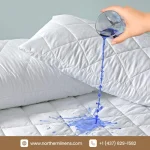
For healthcare settings, some facilities require a liquid-proof, wipe-clean ticking, particularly for patient rooms with higher infection-control standards. For hospitality, a tightly woven cotton or cotton-blend ticking is usually sufficient and more comfortable for guests.
Laundering durability is where cheaper hypoallergenic pillows tend to fail first. A pillow that clumps, flattens, or loses its barrier integrity after a few dozen commercial wash cycles stops protecting anyone, no matter what the original label claimed.
How Northern Linens’ Team Handles This
Fabric and fill consistency issues usually trace back to inconsistent raw material batches, which is one of the most common problems our Production and Quality Control teams catch before a shipment goes out. Every batch is checked against the same spec, so a reorder six months from now performs the same as your original order. If a batch doesn’t meet spec, it gets flagged and resolved internally rather than becoming a problem your facility discovers after the pillows are already in use.
Fire Safety Compliance for Hospitality and Healthcare
Fire codes for commercial bedding and soft furnishings vary depending on your region and the type of facility you operate. Hospitality properties, healthcare facilities, and institutional buyers may all fall under different requirements, so this is not a one-size-fits-all checkbox.
The safest approach as a buyer is to ask your supplier for:
- The specific fire safety standard the product is tested against
- Written test documentation, not just a claim on a spec sheet
- Confirmation that the standard matches what your local jurisdiction actually requires
Never accept “fire safe” as a standalone claim without a named standard attached to it.
Antimicrobial Treatment: What It Does and Doesn’t Do
Antimicrobial treatments on pillow fill or fabric are designed to slow the growth of bacteria, mold, and mildew. They are a helpful layer of protection, but they are not a substitute for proper laundering schedules or a replacement for allergen-resistant fill and fabric.
Ask your supplier two direct questions: what the treatment targets, and how long the treatment is rated to remain effective under your facility’s actual wash frequency. A treatment rated for light residential washing will not hold up under commercial turnover.
Healthcare vs Hospitality: Different Verification Priorities
Healthcare and hospitality buyers are often shopping for the same general product category, but their verification priorities are not the same.
| Priority | Healthcare | Hospitality |
|---|---|---|
| Barrier fabric | Liquid-proof, wipe-clean ticking often required | Tightly woven cotton or cotton-blend ticking usually sufficient |
| Laundering frequency | High, often daily or per-patient | Moderate to high, typically per guest stay |
| Fire code standard | Facility-specific, often stricter | Property-type and region-specific |
| Fill preference | Often foam or treated synthetic for infection control | Down alternative for guest comfort and softness |
[INTERNAL LINK: mattress protectors and pads for healthcare facilities]
Common Sourcing Pitfalls Bulk Buyers Should Watch For
Institutional buyers run into the same handful of problems again and again when sourcing hypoallergenic pillows at scale:
- Vague marketing language with no named certification or test standard behind it
- Inconsistent batches, where the first order performs well but a reorder feels different
- MOQ mismatches, where a supplier’s minimum order quantity doesn’t fit a facility’s actual restocking pace
- Fulfillment delays that leave a property or facility short on inventory during peak turnover periods
How Northern Linens’ Team Handles This
Flexible MOQs are built into how Northern Linens structures wholesale programs, so buyers aren’t forced to over-order just to meet a supplier minimum. Our Wholesale Account Management team works directly with procurement contacts to align order sizes with actual usage and restocking cycles, and our Warehousing and Distribution team maintains regional warehouses in Canada and the USA to support faster fulfillment for facilities that can’t afford long inventory gaps.
Private Label and Custom Hypoallergenic Pillow Programs
Some healthcare groups, hotel brands, and distributors want a hypoallergenic pillow program built around their own specs, whether that’s a specific fill weight, a branded label, or a fabric requirement tied to their infection-control policy.
Private label bedding programs typically involve:
- Defining the required fill type, barrier fabric, and any certification requirements upfront
- Confirming MOQs and production timelines before committing to a SKU
- Running a sample or small batch order before scaling to full production
- Locking in a repeatable spec so every reorder matches the original
How Northern Linens’ Team Handles This
Our Private Label and Custom Development team works with buyers to translate facility requirements, whether that’s an infection-control standard for a healthcare group or a brand-specific comfort spec for a hotel chain, into a repeatable production spec. SKU-level customization means a distributor or hospitality group can lock in a fill, fabric, and label configuration once and reorder against that same spec going forward, rather than re-negotiating details every time.
Restocking and Regional Fulfillment for Institutional Buyers
Bulk bedding programs live or die on restocking reliability. A hypoallergenic pillow that meets every certification standard is still a problem if it can’t reach your facility on a schedule that matches your actual turnover.
Regional warehousing shortens the distance between order and delivery, which matters most for facilities managing urgent restocking needs, such as a hotel group recovering from an unexpected occupancy spike or a healthcare facility replacing bedding after an infection-control event.
How Northern Linens’ Team Handles This
Northern Linens maintains warehouses in Canada and the USA specifically to support faster regional fulfillment for hotels, healthcare buyers, and distributors. This setup is designed to support reliable restocking cycles rather than leaving facilities dependent on long cross-border shipping timelines for every reorder.
A Buyer’s Verification Checklist
Before finalizing a bulk hypoallergenic pillow order, confirm the following with your supplier:
- Request the specific certification names (such as OEKO-TEX Standard 100) and confirm which SKUs they actually apply to
- Ask for written fire safety test documentation matched to your facility’s jurisdiction
- Confirm the fill type and whether it requires a protective casing for laundering
- Ask about barrier fabric weave and whether a liquid-proof option is available if your facility needs it
- Get a straight answer on MOQ and whether it matches your restocking pace
- Ask where the supplier warehouses inventory and how that affects your delivery timeline
- Request a sample or small batch order before committing to a full private label program
[INTERNAL LINK: request a wholesale quote]
FAQs
What certifications should I ask for when buying hypoallergenic pillows in bulk?
At minimum, ask for OEKO-TEX Standard 100 documentation confirming the finished product is free from harmful chemical residues. For hospitality and healthcare, also request written fire safety test documentation matched to your facility’s jurisdiction, since fire codes vary by region and facility type.
Are down alternative pillows better than memory foam for hospitals and hotels?
Down alternative fill is usually easier to manage at scale because it can go through full commercial laundering without a separate protective casing. Memory foam resists dust mite buildup well but typically needs a zippered barrier casing since the foam core itself isn’t fully machine washable.
Does OEKO-TEX certification mean a pillow is organic?
No. OEKO-TEX Standard 100 tests for harmful chemical residues in the finished textile and confirms it’s safe for skin contact. It does not certify organic status, so buyers looking for organic materials need to verify that separately.
How is sourcing hypoallergenic pillows for healthcare different from hospitality?
Healthcare facilities often need liquid-proof, wipe-clean barrier fabric and higher laundering frequency due to infection-control requirements. Hospitality properties generally prioritize guest comfort and can usually use tightly woven cotton-blend ticking with moderate to high laundering frequency.
What’s a reasonable minimum order quantity for a hospital or hotel group?
Reasonable MOQs vary by supplier, but the more important question is whether the MOQ matches your actual restocking pace. Look for suppliers who offer flexible MOQs rather than forcing you to over-order just to meet a fixed minimum.
Can I get a hypoallergenic pillow line custom-branded for my hotel or healthcare group?
Yes, private label and custom development programs let buyers define fill type, barrier fabric, and label requirements upfront, then lock in that spec for repeatable reordering. Most programs start with a sample or small batch order before scaling to full production.
Why do some hypoallergenic pillows stop performing after repeated washing?
Lower-quality fill and fabric can clump, flatten, or lose barrier integrity after repeated commercial wash cycles, which undermines the allergen resistance the pillow was supposed to provide. Ask suppliers for laundering durability data, not just an initial hypoallergenic claim.
Does antimicrobial treatment replace the need for hypoallergenic fill and fabric?
No. Antimicrobial treatment slows the growth of bacteria, mold, and mildew, but it works best as an added layer alongside allergen-resistant fill and a tightly woven barrier fabric, not as a standalone solution.