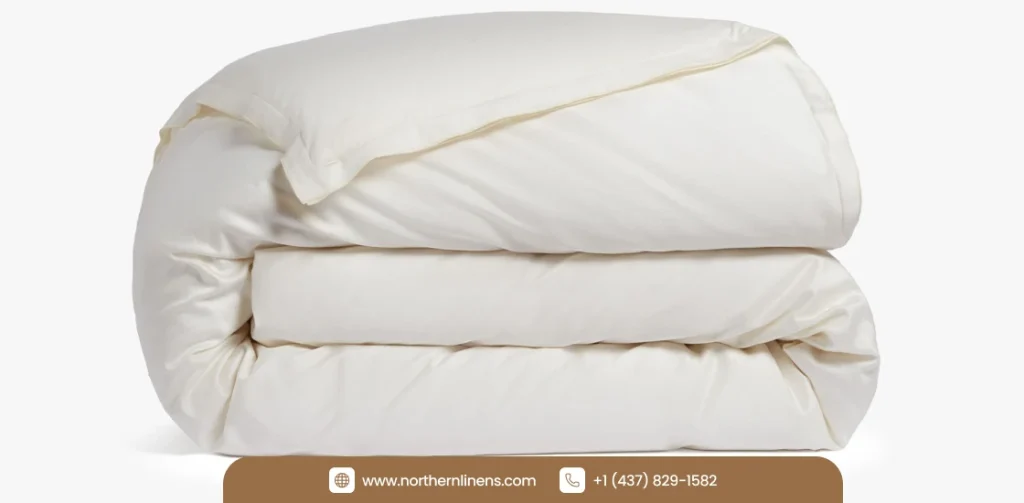
If you run a boutique hotel in Vancouver and want the duvet cover on the bed to carry your name rather than a supplier’s, the logo is the easy part. The five things underneath it are the decision. The fabric, the closure, the size, the label and the minimum order decide whether a private label line survives its first year of commercial laundering. All five are set with the manufacturer before the first sample is sewn. Get them right and the cover is a product you can sell in the room, on your website and to the guest who asks where to buy it. Get them wrong and you own 400 covers with your name on a seam that opened in month three.
In this guide, we take a hospitality brand through sourcing a private label duvet cover line, from specification to the first delivery. The customization choices that matter, the Canadian labelling rules and the questions to settle with the manufacturer come in that order.
What Private Label Means for a Duvet Cover Line
A private label duvet cover is a cover built to your specification and finished with your brand, by a manufacturer that does not put its own name on it. For a hotel, a rental brand or a retailer, it turns a commodity linen item into a product of your own.
Three Levels of Private Label
Private label runs from a woven label sewn into a standard cover to a cover designed from the fabric up. Most hospitality brands sit in the middle.
| Level | What changes | Fits |
|---|---|---|
| Labelled | Your woven label and care label on the manufacturer’s standard cover | A hotel that wants its name on the bed without a new specification |
| Customized | Your choice of fabric, weight, closure, sizing and trim on the manufacturer’s construction, with your labels and packaging | A boutique or luxury property, or a rental brand, building a signature bed |
| Developed | A cover designed with the manufacturer from fabric sourcing to finished product, with your packaging and retail presentation | A retailer or a hospitality group launching a bedding line for sale |
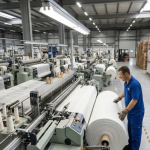
Northern Linens builds all three in its own facility, where cutting, sewing and packaging happen under one roof on OEKO-TEX certified fabric. Private label packaging is available across the full range rather than on selected lines.
Why Hospitality Brands Do It
A private label line earns its place in three ways. The bed becomes part of the brand, which is why boutique and luxury properties lead the category. The cover can be sold, in a room retail program, on your website or through a retail partner, at a margin a supplier’s branded product does not leave you. The specification is yours as well, so a reorder in two years is the same cover, not whatever the supplier’s catalogue has moved to.
- Brand presence on the item guests touch most
- A retail product with your margin on it
- A fixed specification that reorders match
- Control over fabric, closure and sizing instead of a catalogue choice
Who Private Label Suits and Who It Does Not
A single property with 20 rooms rarely reaches the minimums that make a customized line worthwhile, and a labelled cover on a standard construction serves it better. A boutique group in Vancouver or Toronto reaches them easily. So does a luxury property with a retail program, a vacation rental or Airbnb brand with 50 or more units in Montreal or Calgary, or a bedding store building its own line. The test is whether you will reorder the same cover for several years, because a private label specification pays back on the second order, not the first.
Customization Choices That Decide How the Cover Performs
The brand goes on last. The choices below are made first, and each one changes how the cover launders, how long it lasts and what it costs.
Fabric, Weave and Weight
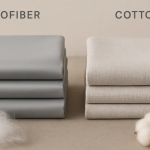
The fabric decides the hand feel, the laundering behaviour and most of the price. Hospitality covers are built in cotton, cotton-polyester blends and microfiber, in percale or sateen weaves, at thread counts chosen for commercial washing rather than for the label.
| Fabric | Feel and look | Commercial laundering | Where it fits |
|---|---|---|---|
| Cotton percale, 200 to 300 thread | Crisp, matte, cool | Washes at high temperatures, holds up well, creases unless pressed | Boutique and luxury rooms with an outsourced or on-site laundry |
| Cotton sateen, 300 to 400 thread | Smooth, slight sheen, warmer | Washes well, softens with use, shows wear sooner than percale at the same weight | Luxury rooms where hand feel leads |
| Cotton-polyester blend, 50/50 to 60/40 | Smooth, low crease | Fast drying, holds colour, longest life in a commercial cycle | Hotels and rental brands turning rooms daily |
| Microfiber | Soft, light, wrinkle-resistant | Dries fastest, lowest cost, less breathable | Rental units and budget rooms where turnaround leads |
A private label line for a boutique or luxury property usually runs percale or sateen in cotton. Where the sheet set is bamboo, the cover follows it. A rental brand turning covers daily usually runs a blend. The specification names the weave, the thread count and the weight in grams per square metre, so a reorder matches.
Closure, Ties and Trim
The closure is where a duvet cover fails, and the choice is the most important customization after the fabric. A hidden zipper closes fastest and holds the insert best, and a quality zipper outlasts the fabric. Buttons look traditional and slow the changeover. An envelope pocket has nothing to break and lets the insert shift. Interior corner ties hold the insert in place through a guest’s night and a housekeeper’s change, and they are the detail guests notice when they are missing.
- Hidden zipper for speed and security, with a zipper rated for repeated commercial washing
- Interior corner ties at all four corners, long enough to tie around a duvet loop
- Piping, hemstitch or a woven stripe as the visible brand detail, in a thread that survives the wash temperature
- A plain hem where the cover is sold at retail and the packaging carries the brand
Sizing to the Bed and the Insert
A cover is sized to the insert, and the insert is sized to the bed with the drop the property wants. A hotel queen on a 60 by 80 inch mattress with a 10 to 14 inch drop runs an insert and cover close to 90 by 96 inches. A king on 76 by 80 runs close to 106 by 96. A rental brand with a mix of beds specifies a cover per bed size, and a retailer specifies to the consumer sizes the store sells. Shrinkage after the first commercial wash is built into the cut, so the cover that arrives is slightly larger than the cover that comes out of the dryer.
Sourcing Private Label Duvet Covers: Minimums, Labelling, Samples and Lead Times
The specification above is what a manufacturer quotes against. Four things then decide whether the order is placed and when it arrives.
Minimum Orders and Pricing
A labelled cover on a standard construction has a low minimum, because the manufacturer is adding a label to a product it already runs. A customized cover has a minimum set by the fabric cut and the sewing run, commonly in the low hundreds of units per size and colour. A developed line has a minimum set by the fabric mill. Price falls with volume at each level. A brand ordering one size in one colour reaches the lowest unit price faster than one spreading the same quantity across four sizes.
| Level | Typical minimum | What drives the price |
|---|---|---|
| Labelled | Small, often a single carton per size | Label cost on the standard unit price |
| Customized | Low hundreds per size and colour | Fabric weight and weave, closure, trim, number of sizes and colours |
| Developed | Set by the mill’s fabric minimum | Fabric sourcing, development time, packaging |
Northern Linens quotes a private label line on the product list and room count you send, with pricing, lead times and samples returned together. No account is needed to ask. Request a quote with the sizes, the quantity per size and the fabric you have in mind, and the quote comes back against that specification.
The Labelling Rules in Canada
A duvet cover sold or supplied in Canada falls under the Textile Labelling Act, and a private label line is labelled in your name, so the obligations are yours. The label has to show the fibre content of the cover as a percentage by mass for every fibre at 5 percent or more, in both English and French. The label also has to show the identity of the dealer, either your company name and postal address or a CA identification number from the Competition Bureau. A bilingual fibre declaration cannot be split across separate labels unless the labels touch, and the label on a cover has to survive repeated washing.
- Fibre content by generic name and percentage, bilingual, for every fibre at 5 percent or more
- Your company name and postal address, or your CA number, which costs $100 to register
- A permanent label that stays legible through commercial laundering
- Care instructions, which are not mandatory under the Act but are expected by every laundry and every retail buyer
- Country of origin where required, which need not be bilingual
A Canadian manufacturer building your line sews the compliant label at production, with your CA number or address on it, and the care label beside it. A line sourced abroad arrives with whatever the factory printed, and relabelling 400 covers is a cost the quote did not include.
Samples and the Wash Test
A private label order is signed off on a sample, and the sample is only useful after it has been washed the way your laundry washes. Northern Linens sends samples you can wash and put on a bed before you decide. Run the sample through ten cycles at your laundry’s temperature. Check the closure, the ties, the seams, the colour and the shrinkage against the specification. Sign off on what comes out of the dryer rather than what came out of the box.
- Ten commercial wash cycles at your laundry’s temperature and chemistry
- Closure and ties checked after every cycle
- Colour checked against the first wash and the unwashed sample
- Measurements checked after the final cycle against the specified finished size
Lead Times and Reorders
A labelled line on a standard construction ships on the manufacturer’s normal lead time. A customized line adds the fabric cut and the sewing run, and a developed line adds fabric sourcing on top. The reorder is where private label pays, because the specification, the labels and the packaging already exist. A manufacturer that holds your specification runs the second order faster than the first. Northern Linens holds duvet covers and inserts in steady supply for repeat orders, and a private label specification is kept on file so the reorder matches the original.
Set the Specification, Wash the Sample, Then Put Your Name on It
A private label duvet cover line is a specification with a brand on it, and the specification is what you are buying.
- Choose the level that fits your reorder volume, labelled for a single property, customized for a group or a rental brand, developed for a retail line
- Fix the fabric, the weave, the thread count, the weight and the closure before the logo
- Size the cover to the insert and the bed with the drop you want, with shrinkage built in
- Put your fibre content and your CA number or address on a permanent bilingual label
- Wash the sample ten times before you sign off, and keep the specification on file for the reorder
Send Northern Linens your room count, the bed sizes and the fabric you have in mind. The quote comes back with bulk pricing, lead times and a sample to wash. The private label packaging is available across the full product range, so the duvet line can carry the sheets, pillows and protectors with it.
Frequently Asked Questions
Can I private label a duvet cover and the insert together?
Yes. Northern Linens sells duvet inserts and covers together or separately, and a private label line can carry the brand on both, with the insert sized to the cover. A matched set is the usual choice for a retail program, and a cover-only line is the usual choice for a hotel that already holds inserts.
Do I need a CA number, or can I use my hotel’s name and address?
Either. The label has to carry your company name and full postal address or a CA identification number. A CA number keeps the address off the label and costs $100 to register with the Competition Bureau. A hotel that labels one line often uses its name and address, and a retailer with several lines usually registers a number.
What happens if I want to change the fabric on the reorder?
The change is a new specification and a new sample. The label, the packaging and the sizing can carry over. The fabric change means a new wash test before the run, because the shrinkage, the colour and the closure behave differently on a different cloth. Treat it as a new line with an existing brand.
Can a rental brand with 60 units justify a customized line?
Usually yes, because 60 units with two or three covers per bed in rotation is a few hundred covers, which reaches the customized minimum in the main size. The question is whether the brand will reorder the same cover for several years. If it will, the specification pays for itself on the second order.
How is a private label cover different from one I buy with my logo embroidered on it?
Embroidery on a standard cover is the labelled level. The cover underneath is the manufacturer’s construction and specification, which can change between orders. A private label line fixes the specification in your name. The fabric, the closure and the size are the same on every reorder, and the label on the cover is yours rather than the supplier’s.