Hotel percale sheets are chosen on yarn quality rather than thread count. Single-ply long-staple cotton between 200 and 300 threads outlasts a multi-ply fabric advertised at twice the number, because inflated counts are produced by counting plies within a single yarn.
Percale is the default hospitality weave because it survives industrial laundering and comes back looking crisp. Choosing well within it comes down to three things: the quality of the yarn rather than the thread count printed on the packaging, whether the labour cost of pressing pure cotton is worth the feel, and how consistently a supplier can repeat an order across a portfolio.
Managing bedding for one property is a purchasing decision. Managing it across several is an operations problem. Mismatched mattress depths, sheets from three suppliers in one linen room, and a reorder that arrives a shade off the last one all cost housekeeping time every day, and none of it shows up in a price comparison. This guide covers what percale actually is, how to read thread count honestly, the cotton against blend decision, the construction details that determine lifespan, and how to standardise bedding across multiple sites.
Why Percale Is The Hospitality Default
Percale is a plain weave, one thread over and one under, which produces a matte surface, a crisp hand and an open structure that breathes. It is the fabric most guests mean when they describe sheets as feeling like a hotel.
For property management the appeal is practical rather than sensory. The plain weave has no long floats sitting on the surface, so there is less yarn exposed to abrasion from bodies, bed-making and industrial washing. Sateen, which floats several threads across the face to create its sheen, wears through those exposed floats faster and shows pulls more readily.
Percale also presses well. A crisp, flat sheet reads as clean to a guest in a way a soft, draped fabric does not, and that perception matters more in a mid-market room than any fibre claim on a spec sheet.
Our guide to cooling bamboo sheet sets covers the percale and sateen comparison in more detail, along with how weave affects airflow.
Reading Thread Count Honestly
Thread count is the most quoted and least reliable figure in hospitality bedding. Understanding how it is inflated is the difference between buying a durable sheet and buying a number.
What The T Numbers Mean
Hospitality suppliers usually quote percale as T180, T200, T250 or T300, referring to threads per square inch in the finished fabric. Most commercial percale sits in that range for good reason. Below it the fabric feels coarse and thins quickly. Above roughly 300 the weave becomes dense enough to lose the airflow that makes percale worth choosing.
A property manager comparing a T200 quote against a T300 quote is comparing two reasonable options. One comparing a T200 against an 800 count percale is looking at a number that has been manufactured rather than measured.
How Counts Get Inflated
A yarn can be spun as a single strand or as two or more finer strands twisted together. When a fabric is woven from two-ply yarn, some suppliers count each ply separately, so a fabric with 150 actual threads per inch is advertised at 300.
The inflated fabric is not better. Finer plies twisted together are weaker than one thicker single-ply yarn of the same total mass, and they break down faster under commercial washing. A single-ply T250 will normally outlast a two-ply fabric marketed at 500.
Ask every supplier the same two questions: what is the thread count, and is the yarn single-ply or multi-ply. A supplier who will not answer the second question has answered it.
What Actually Predicts Durability
- Staple length. Long-staple cotton produces smoother, stronger yarn with fewer fibre ends poking out of the surface, which means less pilling. Short-staple cotton pills within months in a commercial setting.
- Yarn ply. Single-ply, as above.
- Fabric weight in GSM. Grams per square metre measures how much fibre is actually in the fabric, which thread count does not.
- Finishing. Compacted or pre-shrunk finishes reduce cumulative shrinkage across wash cycles.
Cotton Or Poly-Cotton – A Labour Decision, Not A Fabric One
This is the choice that most affects a property management budget, and fabric price is the smallest part of it.
Where 100 Percent Cotton Wins
Pure cotton breathes better, absorbs moisture better and feels better against skin. It also holds a crisp press, which is why boutique and luxury properties specify it.
Cotton gains strength when wet, which makes it well suited to industrial laundering, and it tolerates chlorine bleach and high wash temperatures better than most fibres. The trade is that it wrinkles heavily out of the dryer, so it needs pressing or ironing to look right on a bed.
Where A Poly-Cotton Blend Wins
A 50/50 or similar blend resists wrinkling, dries faster and generally survives more wash cycles before thinning. For a property turning rooms daily without an on-site press, it comes out of the dryer looking presentable, which removes a labour step from every room.
Two drawbacks are worth knowing in advance. Polyester attracts and holds body oils, so blends grey and yellow over time in a way pure cotton does not, and once that happens bleaching does not reverse it. Blends also breathe less, which some guests notice in warm rooms.
The Honest Recommendation
If a property does not press its flat sheets, specifying 100 percent cotton buys a crispness the guest will never see. The sheets arrive on the bed wrinkled, the premium is spent, and housekeeping absorbs the difference in time spent smoothing beds that will not stay smooth.
Choose on the laundry setup and the labour available, not on the positioning of the property.
Situation | Better specification |
On-site press or flatwork ironer, premium positioning | 100 percent cotton percale |
Boutique property, low room count, pressing feasible | 100 percent cotton percale |
Daily turnover, no pressing capability | Poly-cotton blend |
Off-site laundry with no pressing included | Poly-cotton blend |
Vacation rentals, cleaner-managed washing | Poly-cotton blend |
Mixed portfolio with different laundry setups | Blend across all sites, for consistency |
Info: Ask your laundry, in-house or contracted, whether flatwork pressing is included and at what cost per piece before choosing the fibre. That single figure decides this question more reliably than any comparison of fabric samples.
Construction Details That Decide Lifespan
Sheets rarely fail in the middle of the panel. They fail where they are stitched, gripped and stretched, and those details are worth specifying.
Hems And Stitching
Ask for hem depth and stitch density, then compare across quotes. Deep hems with double-needle stitching hold up to housekeeping pulling sheets taut several hundred times a year. Narrow, single-stitched hems unravel first, and a sheet with a failed hem is unusable while the fabric is still sound.
Fitted sheet corners take the most stress of any part of a linen set. Ask how corners are constructed and whether the elastic is fully encased rather than surface-stitched.
Shrinkage Control
Cotton shrinks. The question is how much and whether the supplier has controlled it. Ask for finished dimensions measured after laundering rather than before, and for a stated shrinkage allowance over a defined number of washes.
A fitted sheet that shrinks past its pocket depth becomes a daily fight for housekeeping and eventually an early replacement, even though the fabric has years left in it.
Colourfastness
For white linens the risk is greying rather than fading. Ask what test standard the supplier uses and what result the fabric achieved. On coloured or piped items, ask specifically about performance under chlorine bleach if your laundry uses it.
Standardising Bedding Across Multiple Properties
Managing one property is about the sheet. Managing several is about making every linen room behave the same way, and this is where most of the recoverable cost sits.
Size Identification In A Shared Linen Room
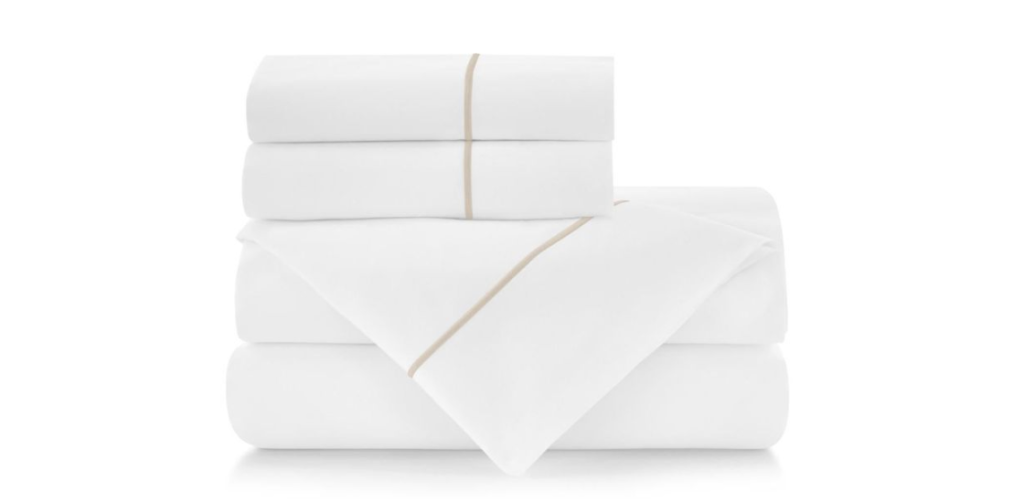
Folded flat sheets look identical across sizes. Housekeeping staff pulling from a shelf under time pressure guess, guess wrong, and walk back. Colour-coded hem threads, a different colour stitched into the hem for each bed size, remove the guesswork entirely.
Specify the coding at the order stage and keep the same colours across every property. A system that differs between sites is worse than no system, because staff moving between properties apply the wrong one.
Mattress Depth Across A Portfolio
Mixed mattress depths within a portfolio guarantee a proportion of poor fits every day. Where possible, standardise mattresses and toppers so one pocket depth serves everything.
Where that is not possible, order two pocket depths, keep them visually distinguishable, and record which properties and floors use which. Ordering a single depth for mixed mattresses produces sheets that pop off in some rooms and bunch in others.
Par Levels And Replacement Planning
Hospitality operations commonly hold three par levels of linen inventory: one set on the bed, one in the linen room, one in the wash. Properties with off-site laundry or longer turnaround usually need more.
Set par levels per property rather than across the portfolio, since occupancy and turnaround differ, then track replacements by property. A single site consuming linen faster than its neighbours usually has a laundry problem rather than a bedding problem, and replacing the sheets will not fix it.
Batch Consistency Between Reorders
A portfolio reorders continuously, which means new stock enters linen rooms alongside older stock. If lots vary in shade or weight, two rooms in the same corridor look different and guests notice.
Ask any supplier directly how lot-to-lot variation is controlled, whether an approved specification is retained between orders, and whether they can supply from the same production run for a property-wide rollout.
Buying, Testing And Reordering
Test before a portfolio-wide commitment. Run sample sets through your own laundry at your own settings for at least 20 cycles, measuring shrinkage, fit, surface condition and colour against an unwashed control set. Our guide to cooling bamboo sheet sets sets out the trial protocol in full.
Beyond the fabric, five questions determine whether a supplier suits multi-property buying:
- What is the minimum order quantity, and does it change on reorders?
- Is an approved specification retained so future orders match the one we sign off?
- Where is stock warehoused, and what are reorder lead times?
- Do you manufacture in house or source from third parties?
- Can you supply custom sizes, colour-coded hems or private label packaging?
A supplier holding Canadian stock can replace a damaged par level in days. One manufacturing in house can hold a specification steady across years of reorders rather than passing along whatever a third party produced that quarter.
Final Thoughts
Percale earns its place because the plain weave exposes less yarn to abrasion and presses back to crisp after every cycle. Within it, buy the yarn rather than the number. Single-ply long-staple cotton between T200 and T300 outlasts a multi-ply fabric advertised at double the count, and fabric weight tells you more about durability than thread count does.
The cotton against blend decision belongs to the laundry, not the marketing. A property without pressing capability that specifies pure cotton pays a premium for crispness the guest never sees. Across multiple sites, standardisation returns more than any specification upgrade: matched mattress depths, colour-coded hems, par levels per property, and a supplier who repeats an order without a shift in shade.
Northern Linens manufactures hospitality percale in house, holds approved specifications between orders and warehouses in Canada. Request sample sets and test them in your own laundry before committing a portfolio.
Frequently Asked Questions
What Thread Count Should Hotel Percale Sheets Be?
Most commercial percale sits between T180 and T300, and anything within that range is reasonable. Counts advertised well above it are usually inflated by counting individual plies within a yarn. A single-ply T250 typically outlasts a multi-ply fabric sold as 500.
Are Percale Sheets Good For Commercial Laundering?
Yes. The plain weave has no long surface floats to abrade, and cotton gains strength when wet rather than losing it, which suits the mechanical stress of industrial washing. Percale also tolerates chlorine bleach and high wash temperatures better than most fibres used in hospitality bedding.
Should Property Managers Choose Cotton Or Poly-Cotton Sheets?
It depends on pressing capability. Pure cotton feels better and presses crisp but wrinkles heavily from the dryer. A poly-cotton blend resists wrinkling and lasts longer, though polyester holds body oils and greys over time. Properties without pressing generally get better value from a blend.
What Is The Difference Between Percale And Sateen?
Percale is a plain one-over-one-under weave that is matte, crisp and breathable, with no long threads exposed on the surface. Sateen floats several threads across the face for a smooth sheen, which feels more luxurious but breathes less and wears through those floats sooner.
Why Do Hotel Sheets Have Coloured Threads In The Hem?
The colour identifies the bed size. Folded flat sheets look identical across sizes, so a coded hem thread lets housekeeping pull the right size from a shelf without unfolding it. Keeping the same colour system across every property prevents errors when staff move between sites.
How Many Sets Of Sheets Does A Property Need?
Three par is the common baseline: one on the bed, one in the linen room and one in the wash. Properties using off-site laundry or with longer turnaround times generally need more. Par levels should be set per property, since occupancy and laundry turnaround vary between sites.