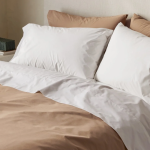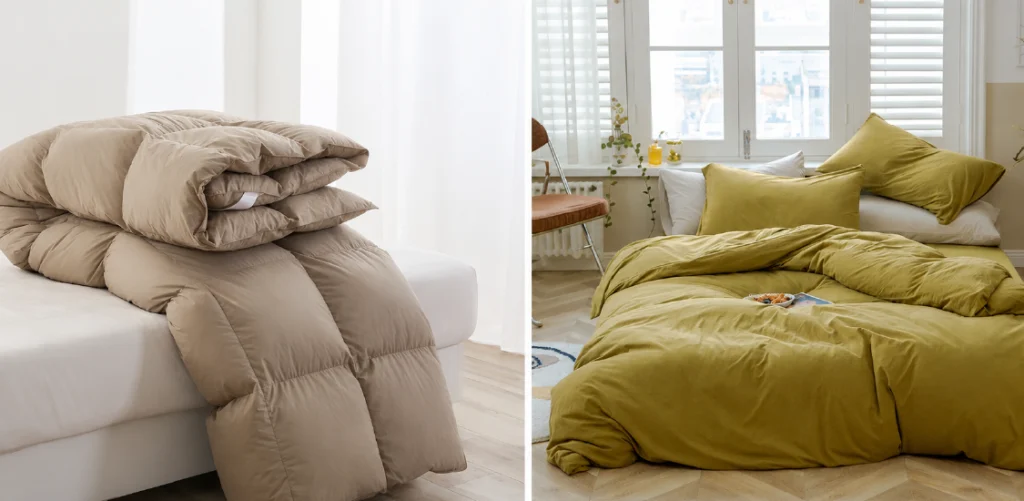
A duvet is a two-piece system made of a fill insert and a removable washable cover, while a comforter is a single quilted piece with the filling stitched directly into the outer fabric. For hospitality and healthcare procurement, this structural difference drives nearly every other decision, including laundering cost, hygiene protocol, replacement cost, and how fast housekeeping can turn a room.
Buyers switching suppliers or comparing formats for the first time often get tripped up by inconsistent terminology, since “duvet,” “comforter,” and “bedspread” get used loosely and sometimes interchangeably across supplier catalogs. This guide separates the terms clearly and maps each format to the property types and use cases it actually fits best.
What Is a Duvet? A Clear Definition for Procurement Buyers
A duvet is a soft, flat insert filled with down, down-alternative, or synthetic fiber, designed to be enclosed inside a separate, removable duvet cover.
The insert itself is never laundered on a regular basis. Housekeeping strips and washes only the cover between guest stays or on a set schedule, while the insert stays inside a protective layer and gets laundered far less often.
This two-piece structure is what separates a duvet system from every other bedding format on this list. The cover functions like a large, quilted pillowcase, closing with a zipper or button closure so it can be removed and replaced quickly.
What Is a Comforter? A Clear Definition for Procurement Buyers
A comforter is a single, pre-assembled bedding piece where the fill is quilted and stitched directly to the outer fabric shell, creating one unit that never separates into layers.
Because the filling is sewn into the shell, a comforter cannot be laundered as just a cover. The entire bulky item goes through the wash or dry-clean cycle as one piece, every time it needs cleaning.
Comforters are typically sold ready to use straight out of packaging, without any assembly step. This is the main convenience advantage comforters hold over duvet systems.
Duvet vs Bedspread: Where This Third Term Fits In
A bedspread is a decorative top layer that covers the entire bed down to the floor or near it, distinct from both duvets and comforters, which typically sit within the mattress dimensions.
Bedspreads are often lighter than duvets and comforters and are used more for daytime appearance than for warmth or nightly bedding function. Some hospitality properties layer a bedspread over a duvet or comforter for visual presentation, then remove it before the guest sleeps.
Procurement buyers comparing “bedspread vs duvet” are usually deciding between a decorative top layer and a functional sleeping layer, not choosing a direct substitute. The two often coexist in the same room specification rather than replacing one another.
Duvet vs Comforter: Full Comparison Table
| Factor | Duvet System (Insert + Cover) | Comforter (Single Piece) |
|---|---|---|
| Structure | Two pieces: insert and removable cover | One piece, filling stitched to shell |
| Laundering frequency | Cover washed frequently, insert washed rarely | Entire piece laundered every time |
| Laundering load on machinery | Lower, lightweight cover only | Higher, bulky item stresses machines and slows drying |
| Room turnover speed | Faster, cover swap is quick | Slower, full comforter change and inspection take longer |
| Upfront cost | Higher, insert and covers priced separately | Lower, single ready-to-use product |
| Replacement cost over time | Lower, only the cover needs replacing when worn | Higher, entire unit discarded when worn |
| Hygiene control | Strong, rapid cover stripping supports frequent sanitation | Weaker, less frequent full laundering of the whole piece |
| Perceived luxury | Higher, associated with upscale hospitality presentation | Lower to moderate, seen as a practical, budget-friendly option |
| Staff labor | Slightly higher, cover must be fitted onto insert | Lower, no assembly step required |
| Best fit | Upscale hotels, healthcare, high-turnover properties | Budget hospitality, lower-turnover properties |
Hygiene and Sanitization: Why This Matters Most for Healthcare Buyers
Healthcare procurement buyers should prioritize duvet systems over comforters whenever infection control standards require frequent, high-temperature laundering.
A duvet cover can be stripped and laundered at high temperatures for thermal disinfection without repeatedly stressing or degrading the insert underneath it. This matters directly for infection control protocols that call for frequent linen turnover between patients or care settings.
Comforters do not offer this separation. Washing the entire quilted unit at the frequency healthcare hygiene standards often require puts continuous mechanical and thermal stress on the same piece that holds both the outer fabric and the fill, shortening its usable life much faster than a duvet insert experiences under the same protocol.
For hospitality properties, hygiene stakes are different but still meaningful. Upscale hotels lean toward duvets partly for the aesthetic, but the ability to rotate covers quickly between stays also supports a higher standard of surface cleanliness without requiring the entire bedding piece to go through the wash after every guest.
How Northern Linens’ Team Handles This
Northern Linens manufactures duvet inserts and duvet covers as separate, consistently specified products, which lets healthcare and hospitality buyers order covers in higher volume for frequent rotation while ordering inserts at a lower replacement cadence. The Wholesale Account Management team can help buyers structure a cover-to-insert ratio that matches their actual laundering frequency, so cover stock never runs short during a high-turnover stretch.
Cost and Total Cost of Ownership: Duvet vs Comforter
Comforters cost less upfront because they are a single manufactured product, while duvet systems typically deliver lower total cost of ownership over time because only the cover needs replacing when it wears out.
Upfront cost comparison:
- Comforters are priced and sold as one ready-to-use item, which keeps the initial purchase simpler and cheaper per unit.
- Duvets require buying both an insert and one or more covers, which raises the initial procurement cost per bed.
Long-term cost comparison:
- Comforters must be fully replaced once the shell fabric or filling wears out, discarding the entire unit even if only the fabric surface shows damage.
- Duvets allow a buyer to replace just the cover when it stains or wears, while the insert continues serving its full lifespan underneath.
This is the core tradeoff procurement buyers need to weigh: comforters minimize upfront spend, while duvet systems minimize long-term replacement spend, particularly for properties with high wash frequency or high guest turnover.
How Northern Linens’ Team Handles This
Northern Linens’ Wholesale Account Management team models total cost of ownership against a buyer’s actual turnover rate and laundering frequency, rather than comparing sticker prices alone. Buyers with high-turnover properties often find that duvet systems pay back the higher upfront cost within a shorter timeframe once cover-only replacement savings are factored in, while lower-turnover properties may find comforters remain the more efficient choice.
Which Format Fits Which Property Type
Property type and turnover rate are the two biggest factors in choosing between duvets and comforters, more so than budget alone.
Luxury hotels and boutique resorts generally favor duvet systems for the high-loft, upscale appearance guests associate with premium stays, combined with the ability to rotate covers quickly between bookings.
Budget hotels and motels often favor comforters, since they eliminate the labor step of fitting an insert into a cover and keep upfront procurement costs lower across a large room count.
Healthcare and institutional buyers typically need duvet systems specifically for the infection control advantages of frequent, high-temperature cover laundering without repeatedly stressing the insert.
Short-term rental operators sit in between, often choosing comforters for simplicity across scattered properties with less centralized laundering, though larger rental portfolios with in-house laundering sometimes shift toward duvets as turnover volume grows.
Regional and national distributors supplying multiple property types usually need both formats in inventory, since their buyers span the full range of turnover rates and budget levels above.
Switching Suppliers: A Terminology Checklist for Procurement Buyers
Buyers switching bedding suppliers should confirm exact terminology before placing an order, since “duvet,” “comforter,” and “insert” are used inconsistently across the industry.
- Confirm whether “duvet” means the insert alone or the insert plus cover. Some suppliers list these as one SKU, others sell them separately.
- Check fill type and weight specification, since down, down-alternative, and synthetic fills vary significantly in loft and laundering needs even within the duvet category.
- Verify cover closure type. Zipper closures generally hold up better under frequent removal and reattachment than button or tie closures in high-turnover settings.
- Ask whether the comforter is described as “quilted” or “stitched-through.” These terms usually confirm the fill is permanently attached, which is the defining trait of a true comforter.
- Clarify MOQ structure for inserts versus covers separately, since a supplier with flexible MOQs on covers alone can support more frequent cover-only reordering.
How Northern Linens’ Team Handles This
Northern Linens’ Private Label and Custom Development team works directly with buyers moving from another supplier to confirm fill type, weight, and cover specifications match what a property actually needs, rather than assuming terminology carries over cleanly between suppliers. This reduces the risk of a buyer reordering the wrong format or fill weight during a supplier transition.
Common Mistakes When Procuring Duvets or Comforters
Most procurement mistakes in this category come from treating duvets and comforters as interchangeable rather than structurally different products with different lifecycle costs.
- Choosing comforters purely for lower upfront cost without accounting for full-unit replacement cost down the line.
- Underordering duvet covers relative to actual turnover rate, leaving housekeeping short on clean covers during peak occupancy.
- Assuming all “duvets” ship as insert plus cover, when some suppliers sell the insert alone by default.
- Ignoring fill weight differences across seasons, ordering one fill weight year-round instead of adjusting for climate or season.
- Overlooking healthcare-specific laundering requirements when specifying bedding for care settings, defaulting to standard hospitality specifications instead.
Frequently Asked Questions
Is it better to buy a comforter or a duvet for a hotel?
It depends on turnover rate and budget priorities. Comforters cost less upfront and fit budget properties with lower turnover, while duvets cost more initially but reduce long-term replacement costs and support faster room turnover in high-volume hotels.
Do luxury hotels use duvets or comforters?
Most luxury hotels and boutique resorts use duvet systems, since the high-loft appearance and quick cover-rotation capability align with premium guest presentation standards and frequent housekeeping turnover.
What is the main difference between a duvet and a comforter?
A duvet is a two-piece system with a removable cover over a separate insert, while a comforter is a single piece with the filling permanently stitched to the outer fabric. This structural difference drives laundering frequency, cost, and hygiene differences between the two formats.
Why do healthcare facilities prefer duvet covers over comforters?
Duvet covers can be stripped and laundered at high temperatures for infection control without repeatedly stressing the insert underneath. Comforters require laundering the entire bulky unit at that same frequency, which wears the piece out faster and complicates rapid turnover between patients.
What is a bedspread compared to a duvet?
A bedspread is a decorative top layer that typically covers the bed down to the floor, used more for daytime appearance than nightly warmth. It is often used alongside a duvet or comforter rather than as a direct substitute for either.
How often should duvet covers be laundered in a hotel setting?
Laundering frequency depends on property standards and occupancy, but duvet covers are typically laundered between guest stays or on a set rotation schedule, while the insert underneath is laundered far less often since it stays protected inside the cover.
Are duvet inserts more expensive to replace than comforters?
Duvet inserts are generally replaced less often than comforters, since only the cover wears out from frequent laundering in most cases. Over the full lifecycle of the bedding, this typically makes duvet systems less expensive to maintain than comforters, even though the initial purchase price is higher.
Can a hotel switch from comforters to duvets without major cost disruption?
Yes, though buyers should plan the transition around actual turnover rate and laundering frequency to confirm the long-term savings justify the higher upfront cost. Working with a supplier that offers flexible MOQs on both inserts and covers makes it easier to phase in the switch gradually rather than replacing an entire property’s inventory at once.